Servo motor testing
Real tester screens and the final run test.
TestingSince 2000 · 3,000+ customers

Motor testing
Star Automations tests servo, BLDC, permanent-magnet, EC fan and EV motors before and after refurbishment. The tests cover insulation resistance, hipot (AC withstand), phase resistance balance, back-EMF, encoder, resolver and Hall feedback, and a run and load test. Each result is recorded against a limit and goes on the report sent with the motor. Testing is also offered as a separate job for OEMs, importers, maintenance teams and repair shops.
Each test looks at a different part of the motor. A motor can pass one and fail another, so a single check is not enough to send it back to a machine.
An insulation resistance reading shows the general condition. A hipot test stresses the insulation at a higher voltage and finds weak spots that a resistance reading can miss.
A shorted turn or a loose joint can let a motor run on the bench and then overheat on the machine. Phase resistance balance and back-EMF show it before it ships.
Encoder, resolver and Hall faults are often intermittent. They are read while the motor rotates, then the motor is run on a drive.
Bearing, brake and magnet problems often appear under torque and not at no load. A load test is the last check before the motor goes back.
The tests applied depend on the motor type, its rating and what the inward inspection finds. They are agreed in the quote.
| Test | What it checks | What it catches |
|---|---|---|
| Insulation resistance (IR, megger) | Resistance between the windings and the frame at a DC test voltage | Moisture, contamination and aged insulation |
| Hipot (AC withstand, dielectric test) | That the insulation holds a voltage well above working voltage for a set time, with leakage below a limit | Weak spots, pinholes and tracking that an IR reading can pass |
| Phase resistance balance | Equal resistance across the phases | Shorted turns, open coils and loose or high-resistance joints |
| Back-EMF (permanent-magnet motors) | The voltage the motor generates when it is turned | Weakened magnets and winding faults |
| Encoder, resolver and Hall feedback | Signals, counts and alignment to the rotor | Feedback faults, signal dropouts and misalignment |
| Run test | Current, noise, vibration and temperature while running on a drive | Bearing, brake and assembly faults |
| Load test | Behaviour under torque on a drive | Faults that appear under load but not at no load |
| Dynamic balancing | Residual unbalance of the rotor or impeller | Vibration that wears bearings early |
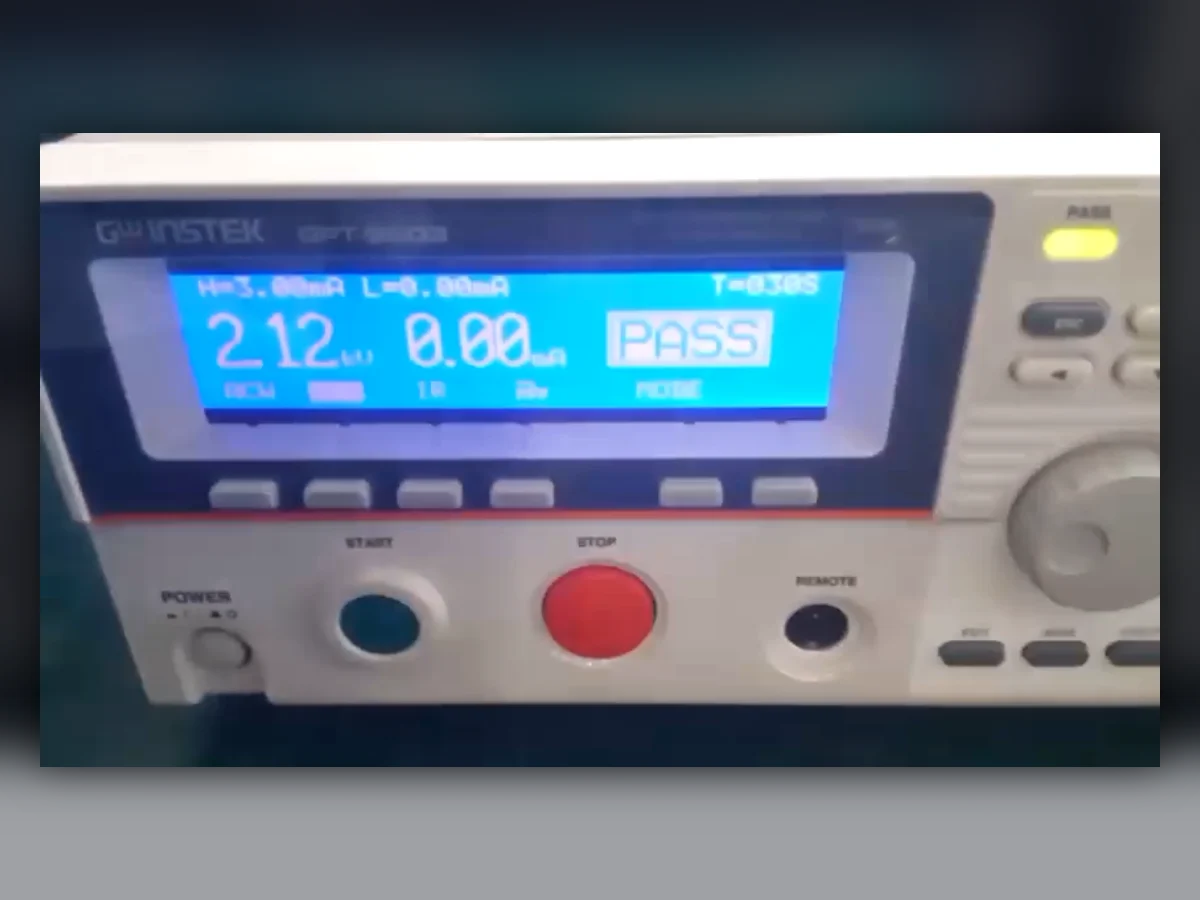
The motor's windings are connected to the tester's high-voltage lead and the frame to the return. The tester applies 2.12 kV AC for 30 seconds, with the leakage limit set at 3.00 mA.
Leakage stays at 0.00 mA through the test and the tester shows PASS. A breakdown, or leakage above the limit, stops the test and shows FAIL.
What it tells you: the insulation was stressed well above working voltage and held. The test voltage, leakage limit, time and result go on the report.
A hipot (high-potential, or dielectric withstand) test applies a voltage well above the motor's working voltage between the windings and the frame for a set time. It shows whether the insulation can hold that stress without breaking down.
The test voltage depends on the motor's rated voltage and its condition. IEC 60034-1 sets the withstand voltage for new rotating machines. Repaired and in-service motors are tested at a reduced voltage, so the test checks the insulation without over-stressing it.
Motors with built-in electronics, such as EC fans and some BLDC motors, are tested with the electronics isolated or with the test set to suit, following the maker's guidance.
The same order for every motor, from the safest test to the most demanding, so a fault is found before it can do more damage.
Nameplate, photos and the reported fault are recorded. The motor is checked for physical damage before any voltage is applied.
The windings are megger-tested to the frame. A low reading is investigated before going further.
The insulation is stressed at a voltage set from the motor's rating, with leakage recorded against a limit.
Phase resistance balance, back-EMF and encoder, resolver or Hall signals are checked.
The motor is run on a drive, then loaded. Current, noise, vibration and temperature are watched.
Every reading goes on the report, against its limit, and travels with the motor.
Spare motors checked before they go on the shelf, and failed motors tested to decide between repair and replacement.
Incoming inspection, after-warranty and non-warranty returns, and root-cause testing of field failures.
Traction, hub and BLDC motors tested in batches, to your test method and acceptance criteria.
A test report with each motor, for acceptance and records.
Tests your shop does not have the equipment for, with the readings returned to you.
| Run on the bench, nothing more | Tested and reported | |
|---|---|---|
| Insulation | Not known | IR and hipot readings against limits |
| Windings | Not known until it overheats | Phase balance and back-EMF recorded |
| Feedback | Noticed if it fails to run | Signals and alignment checked while turning |
| Under load | Not checked | Run and load test on a drive |
| Evidence for your records | None | A report that travels with the motor |
| Item | Recorded |
|---|---|
| Motor | Make, model, serial number and nameplate rating |
| Insulation resistance | Test voltage and reading for each winding to frame |
| Hipot | Test voltage, leakage limit, time, leakage reading and PASS or FAIL |
| Windings | Phase resistances and balance, back-EMF where applicable |
| Feedback | Device type and the signals checked |
| Run and load | Drive used, speed, current and observations |
A hipot (high-potential) test applies a voltage well above the motor's working voltage between the windings and the frame for a set time, and measures the leakage current. If the insulation holds and the leakage stays below the limit, the motor passes.
Yes, when the test voltage is set correctly. New motors are tested at the full withstand voltage; repaired and in-service motors are tested at a reduced voltage so the insulation is checked without being over-stressed. Motors with built-in electronics are tested with the electronics isolated or as the maker advises.
An insulation resistance test measures how well the insulation resists a DC voltage and shows its general condition, such as moisture or contamination. A hipot test stresses the insulation at a higher voltage to find weak spots that can pass a resistance reading. The two are used together.
It depends on the motor's rated voltage and whether it is new or has been in service. IEC 60034-1 sets the withstand voltage for new rotating machines, and a reduced voltage is used for repaired and in-service motors. The voltage used is written on the report.
Yes. OEMs, importers, maintenance teams and repair shops send motors for testing alone, singly or in batches, to their own test method if they have one.
Yes. The motor is tested with the electronics isolated, or the test is set to suit, so the electronics are not damaged. The drive electronics can also be checked and repaired.
A report with each reading against its limit: insulation resistance, hipot voltage, leakage and result, winding balance, feedback checks, and run and load observations.
WhatsApp the nameplate photo, the quantity and the tests you need to +91 97866 22233, or email info@starautomations.com.