
Servo motor testing · the evidence
Servo motor testing: how we diagnose, align and run-test every repaired motor
Every servo motor we repair is diagnosed on a universal servo motor feedback tester and run on a drive before it goes back. This page shows the screens our technicians work from: the encoder memory read, the signal-level check, the count test, the commutation alignment and the final run. If you are deciding whether to trust a repair shop with a line-critical motor, these are the results to ask for.
Questions maintenance managers ask before trusting a repair shop
A servo motor that fails twice costs more than one that was replaced. These are the questions we hear most, and the evidence we show in answer.
Do they really have test equipment?
Yes. Every screen on this page comes from our own feedback tester, captured on motors at our bench. Ask us for the same screens for your motor.
Was my motor tested, or just cleaned and painted?
Each repair produces measured values: signal levels, counts, commutation angle and run results. They are recorded against your motor's serial number.
Will it run when it goes back on the machine?
The feedback is aligned to the rotor and the motor is run on a drive before dispatch, so your line is not where it gets tried out.
Will a repaired encoder keep the motor data?
On serial encoders that store motor data, the memory is read before work and checked again after, including the commutation offset the drive relies on.
What our tester shows on a real motor
These are unedited screens from motors at our bench, apart from a licence number we have masked. Each step answers a different question about the motor.
Step 1: Read the encoder memory
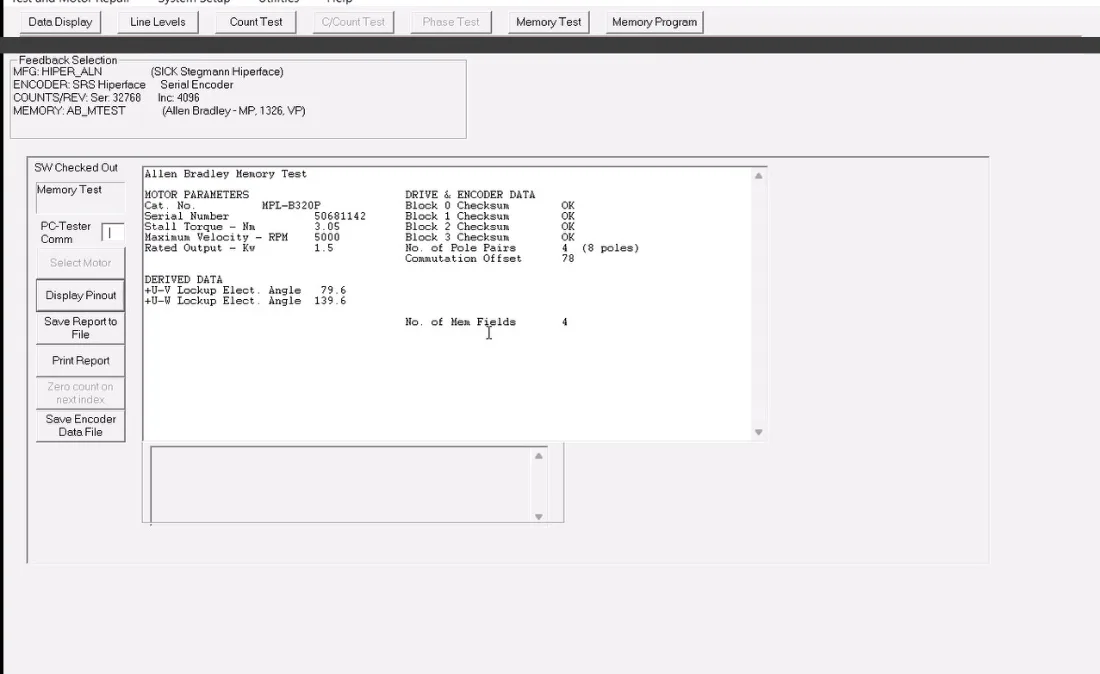
The tester identifies the feedback device and reads its memory as plain values, not hex. On this Allen-Bradley MPL-B320P with a SICK Hiperface encoder, the memory holds the catalogue number, the motor serial number, stall torque, maximum speed, rated output, four pole pairs and the stored commutation offset.
All four memory blocks pass their checksum.
What it tells you: the encoder belongs to this motor and its data is intact. A replacement encoder that arrives blank, or memory that has been corrupted, shows up here before the motor is closed up.
Step 2: Check the signal levels
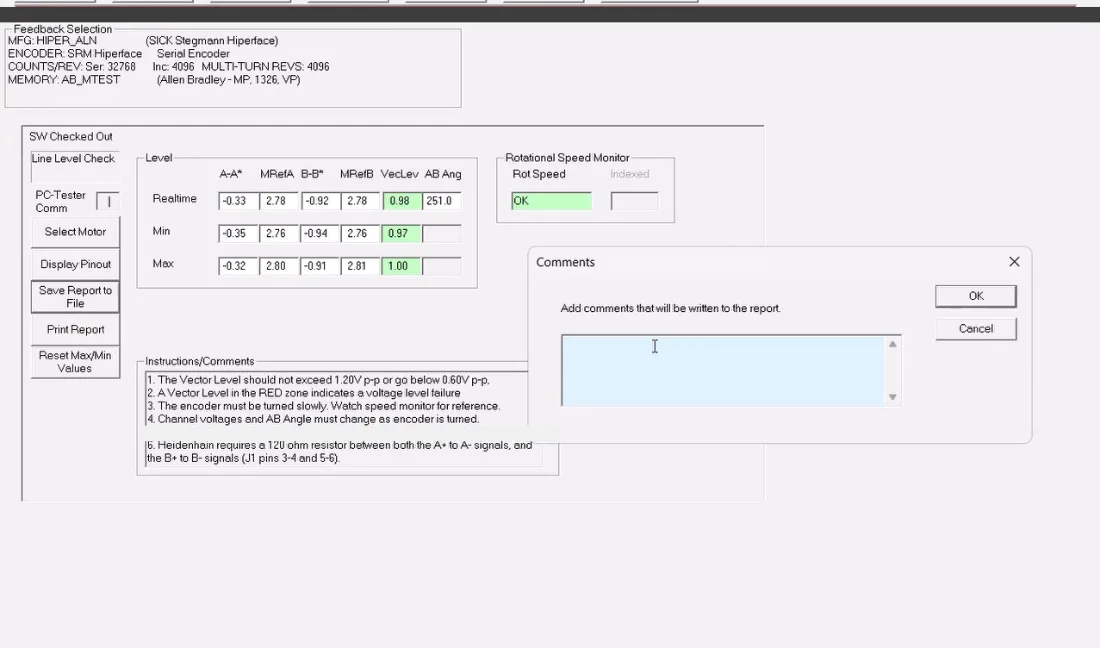
The sine and cosine signals are measured while the shaft is turned slowly, with real-time, minimum and maximum values on screen. The vector level must stay between 0.60 and 1.20 V peak-to-peak. On this encoder it held between 0.97 and 1.00 V, and the speed monitor confirmed steady rotation.
What it tells you: weak or contaminated optics, a failing light source or a damaged feedback cable show up as a low or unsteady level. That is the fault behind many intermittent encoder alarms on the machine.
Step 3: Count every revolution
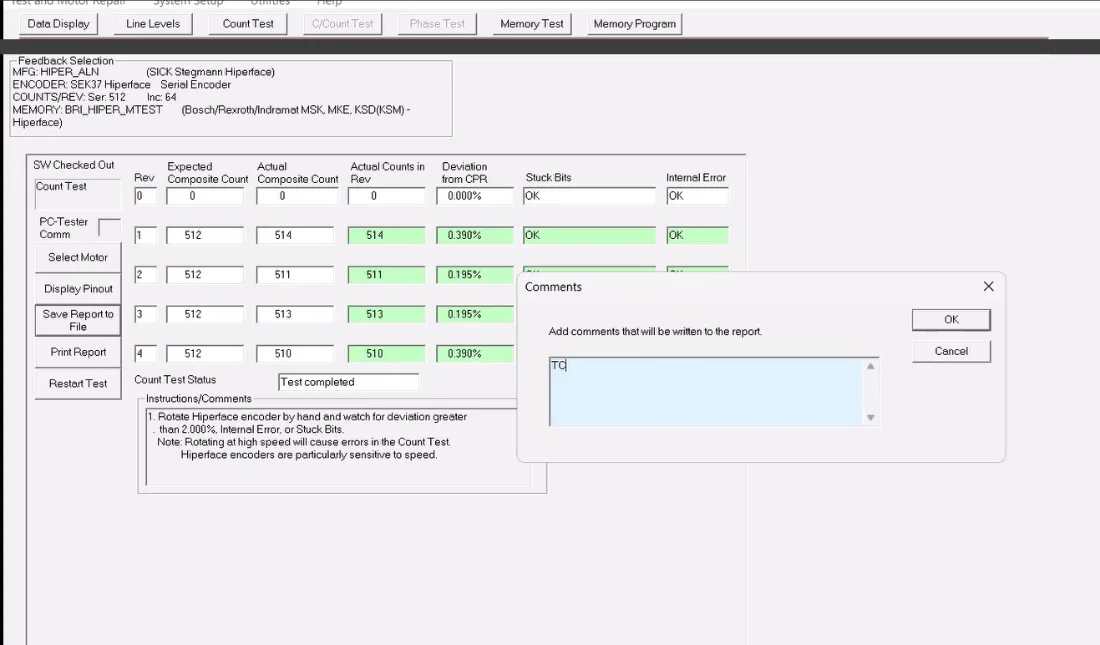
The tester compares the counts the encoder reports in each revolution with the counts it should report, and checks every bit for a stuck bit. This Bosch Rexroth (Indramat) motor with a 512-count Hiperface encoder deviated by 0.2 to 0.4 percent per revolution, inside the 2 percent limit, with no stuck bits and no internal error.
What it tells you: lost counts and stuck bits cause position errors and following-error alarms. Finding them on the bench is cheaper than finding them on a running axis.
Step 4: Align the commutation
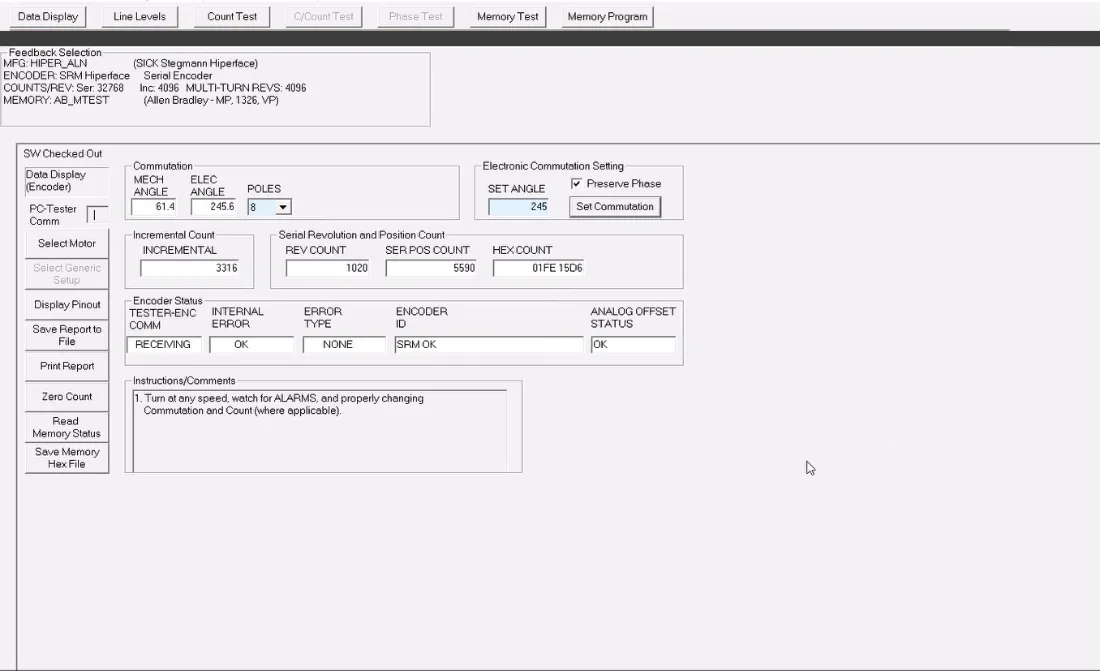
With the motor's pole count set, the tester shows the mechanical and electrical angle live and sets the electronic commutation angle. Revolution count, position count, encoder ID and internal error status are watched for alarms while the shaft turns.
What it tells you: a wrong commutation offset makes a motor run hot, rough or weak, even when every part in it is new. Setting and checking it is what makes the repaired motor behave like the original on your drive.
Step 5: Final run test
The motor is connected to a drive and run at speed, with the speed and current feedback watched on screen. In this video, a repaired Allen-Bradley MPL motor runs on an Allen-Bradley Ultra3000 drive at a 2,000 rpm velocity command.
What it tells you: the motor does not leave until it has run. Ask us if you would like the test screens or the run video for your own motor.
What each test catches, and what it means on your machine
| Test | What it checks | Fault it catches | What you would see on the machine |
|---|---|---|---|
| Encoder memory read | Motor data, checksums, commutation offset | Blank or corrupt encoder memory | Drive alarm at power-up, motor not recognised |
| Signal levels | Sine and cosine amplitude, 0.60 to 1.20 V | Weak or contaminated encoder, cable fault | Intermittent encoder alarms |
| Count test | Counts per revolution, stuck bits | Lost counts, stuck bits | Position and following errors |
| Commutation alignment | Electrical angle against the rotor | Wrong offset after repair | Heat, rough running, low torque, overcurrent trips |
| Final run test | Running on a drive at speed | Anything the static tests missed | Proven before it ships, not on your line |
Servo motor brands, series and feedback devices we test
The motor's catalogue number tells you the series; the encoder's own label tells you the feedback device. Both decide how the motor is tested and aligned. This table lists the combinations we see most often. If your model is not here, send the nameplate and the encoder part number and we will tell you whether we can test it.
| Brand | Motor series (examples) | Feedback devices (examples) | What we read and check |
|---|---|---|---|
| Allen-Bradley (Rockwell) | Kinetix MPL, MPM, VPL; TL and TLY; 1326AB; 8720 spindle motors; 8500 series | SICK Hiperface SRS, SRM, SKS36, SKM36 and SNS; Hiperface DSL on VPL; resolvers on older motors | Memory test with motor data and commutation offset, line levels, count test, alignment, run test |
| Fanuc | Alpha i and beta i servo motors | Alpha i serial pulsecoders, for example A860-2010-T321 and A860-2060-T321 (high-speed 2-wire) | Serial data, count test, memory read and programming, alignment, run test |
| Yaskawa | SGM series, for example SGM-04VW14B and SGM-A5A3TF11X | Incremental UTOPI and UTOPH (UVW and C-channel); absolute UTMAH 12-bit and 15-bit | Count test, commutation pattern, absolute encoder data, memory programming on supported serial types |
| Siemens | 1FT5, 1FT6, 1FK7 | Hall sensors and AC tachogenerator (1FT5); Heidenhain ERN1387, RON3350, EnDat EQN1325 and ECN1313; SSI AG661 | Hall and tach check, EnDat data, line levels, alignment, run test |
| Mitsubishi | HA-SH, HA-LH and other MELSERVO motors | OSA253, OSA105, OSA104, OSE104, OSA17, OSA18, OSA14, OAH14B, OBA13, OBE12, OHE4096 | Serial data, count and stuck-bit test, battery and alarm status, alignment |
| Bosch Rexroth (Indramat) | MSK, MKE, KSD (KSM), MDD, MAC | Hiperface SEK37 and others (MSK, MKE, KSD); Heidenhain (MDD); SSI AG100 (MAC) | Memory test, count test, line levels, alignment, run test |
| Kollmorgen | AKM | Hiperface, Hiperface DSL, BiSS, EnDat, incremental, resolver | Feedback identification, line levels, alignment, run test |
| Panasonic and Japanese robot makers | MINAS MTMA and others; Nachi, Denso, Meiden, Shinko and Kobelco robot axes | Tamagawa TS5643, TS5645, TS5647, TS5648, TS5667, TS5669, TS5778, TS5781, MFE0017 | Serial data, serial count test, memory read and programming on supported types |
| Other makes | SEW-Eurodrive, Baumüller, Berger Lahr, Elau, Schneider Electric, Control Techniques, B&R, Fagor, Baldor, Stöber, Moog, Delta, Omron, Parker, Sanyo Denki, Kawasaki, ABB | Hiperface, EnDat, BiSS, SSI, sin/cos, incremental with UVW, resolvers, Hall sensors | Feedback test, alignment and run test; send the nameplate to confirm |
Feedback device families we test: SICK Stegmann Hiperface (SRS50, SRS60, SRM50, SRM60, SKS36, SKM36, SEK37, SEL52, SNS50, SNS60) and Hiperface DSL; Heidenhain EnDat 2.1 and 2.2 and SSI (ECN413, ECN1313, EQN415, EQN1325, EQI1325, EQI1329, ERN1387); BiSS and BiSS-C; Tamagawa and MFE serial; Fanuc, Mitsubishi and Yaskawa serial; incremental encoders with UVW or Hall tracks; sin/cos 1 Vpp; resolvers; Hall sensors and tachogenerators.
Brand and model names describe the motors we test. We are an independent repairer, not a dealer or service partner of these makers.
How to identify your motor and encoder before you send it
A few details decide most of the work. Photograph them before the motor leaves the machine.
Motor catalogue number
On the motor nameplate, for example MPL-B320P or SGM-04VW14B. It gives the series, frame, voltage and feedback option.
Motor serial number
Also on the nameplate. It is how your motor is traced from inward to dispatch, and it appears in the encoder memory on many serial encoders.
Encoder part number
On the encoder's own label under the rear cover, for example SKM36, EQN1325 or OSA105. Send it if you can see it.
Drive alarm code
The alarm or fault the drive showed, and what the machine was doing when it appeared.
Send it
WhatsApp the photos to +91 97866 22233 and we confirm whether we can test and repair that model.
The test sequence
Each step has to pass before the next one starts. A failure sends the motor back to the bench, not out of the door.
Insulation and hi-pot
Winding-to-frame insulation resistance, then a dielectric withstand test at a voltage set by the motor's rating.
Winding balance
Phase-to-phase resistance and inductance compared for balance.
Feedback and commutation
The encoder or resolver is read on the test system, and the commutation offset is checked against back-EMF.
Brake
Release voltage and holding checked on motors fitted with a brake.
No-load, then full load
A no-load run in both directions, then a run at rated torque on the load rig until temperature settles. Vibration and noise are checked at rated speed.
Why a dedicated feedback tester matters to you
An oscilloscope shows that a signal exists. It cannot read the data stored inside a serial encoder, and checking alignment with it means probing a spinning motor.
A dedicated feedback tester reads many encoder makes and protocols in one place, shows the stored data in plain values so corrupt memory is easy to spot, calculates angles from the motor's pole count, and aligns the encoder with the rotor locked still. For you, that means a repair decision based on measurements, and a motor that is aligned the same way every time.
More on encoder alignment and programming.
What the test report shows
Format sample. Values are illustrative and do not come from a customer's motor. Header: serial no. [logged at inward] · fault as received: encoder alarm at power-up, noise at speed · work done: encoder replaced and aligned, bearings and front seal replaced.
| Check run | Acceptance criterion (example) | Measured | Result |
|---|---|---|---|
| Insulation resistance, winding to frame | ≥ 100 MΩ | > 2,000 MΩ | PASS |
| Hi-pot, winding to frame | No breakdown | No breakdown | PASS |
| Winding resistance balance | Within ±3% | 1.12 / 1.13 / 1.12 Ω | PASS |
| Commutation offset | Within ±2° electrical | 0.6° | PASS |
| Brake release | ≤ 90% rated voltage | 19.8 V | PASS |
| No-load current vs nameplate | Within limit | 1.1 A | PASS |
| Full-load temperature rise | Within insulation class | ΔT 38 K | PASS |
| Vibration at rated speed | ≤ 1.8 mm/s | 0.9 mm/s | PASS |
| Released for dispatch | All checks pass | Yes | RELEASED |
See the full sample servo motor test report.
How to send the motor
You can send a servo motor from anywhere in India. Talk to us before you courier, so the unit is expected and logged on arrival.
Send the nameplate
WhatsApp a clear photo of the nameplate, the alarm code and what the machine was doing when it failed.
We confirm repairability
We tell you whether we can test and repair that model before anything is shipped.
Courier or pickup
Courier the motor to our Chennai, Puducherry or Bengaluru site, or ask us to arrange pickup where needed.
Inspection and quote
The motor is opened, inspected and photographed. You get the findings and a quote before work starts.
Repair, test, dispatch
Repaired, run-tested and load-tested, then dispatched with a printed test report.
How do you test a servo motor encoder?
We read the encoder memory, measure the sine and cosine signal levels while the shaft turns, run a count test for lost counts and stuck bits, align the commutation to the rotor, and then run the motor on a drive.
How can I be sure my servo motor was really tested?
Each repair produces measured values, such as signal levels, counts, commutation angle and run results, recorded against the motor's serial number. Ask for the test screens or the run video for your motor.
What is a commutation offset and why does it matter?
It is the angle between the encoder's zero and the rotor's magnetic poles. If it is wrong after a repair, the motor runs hot, rough or weak and the drive may trip on overcurrent.
Can you test a servo motor without its original drive?
Yes. The feedback tester and run test work across many brands. Allen-Bradley motors can also be run on an Allen-Bradley drive, as in the video on this page.
What is a good signal level for a Hiperface encoder?
The vector level of the sine and cosine signals should stay between 0.60 and 1.20 V peak-to-peak while the shaft turns. A low or unsteady level points to a weak encoder or a cable fault.
What does the servo motor test report include?
The fault as received, the work done, insulation and winding checks, feedback and commutation results, the run test, and whether the motor was released.
Which Hiperface encoders can you test?
SICK Stegmann Hiperface encoders including SRS50, SRS60, SRM50, SRM60, SKS36, SKM36, SEK37, SEL52, SNS50 and SNS60, and Hiperface DSL encoders on motors such as Allen-Bradley VPL and Kollmorgen AKM.
Do you test Heidenhain EnDat encoders on Siemens motors?
Yes. EnDat encoders such as EQN1325 and ECN1313 on Siemens 1FT6 and 1FK7 motors are read, checked for signal level and aligned, and the motor is run before return.
Can you test Mitsubishi and Tamagawa serial encoders?
Yes. Mitsubishi OSA, OBA and OSE encoders and Tamagawa TS-series serial encoders are read, count-tested and checked for alarms. Send the encoder part number to confirm your model.
Send the nameplate. We confirm repairability before you courier.
WhatsApp a nameplate photo and the alarm code to +91 97866 22233, or email info@starautomations.com.