
Bengaluru · Battery drain and charger testing
Battery Drain and Charger Testing Service in Bengaluru
Using a Keysight 66319D mobile communications DC source and a Keithley 2306 battery/charger simulatorStar Automations tests battery-powered devices and chargers from our Bengaluru office in Mahadevapura. We power your device from a simulated battery, record its current drain in sleep, idle and active states, and test chargers and charging circuits against a simulated battery. You get a test record for every unit: the set conditions, the measured values, the graph or log where available, and a pass or fail result against your limits. Use us for outsourced characterisation, production overflow, post-repair checks or on-site sessions.
Important: This is an in-house electrical test and test record service for design checks, production, validation and post-repair testing. It is not NABL-accredited testing, and it is not BIS, CE, AIS-140 or RF certification. Our records do not replace a certified laboratory's report. For accredited certification, please use a NABL- or BIS-recognised laboratory.
- 25+ years in industrial electronics repair and testing
- Pondicherry, Chennai, Bengaluru, Hyderabad, Delhi
- A test record for every unit
Pick your device
Wearable or TWS earbuds
Sleep, burst and run-down profiles.
IoT sensor or module
Sleep and wake current profiling.
Vehicle tracker
Sleep, tracking and transmit states.
Charger or power bank
Charger tests against a simulated battery.
BMS board, low voltage
Bench checks inside 15 V.
Repaired device
Post-repair power check with a record.
What is battery drain testing?
Battery drain testing measures how much current a battery-powered device draws in each state, such as sleep, idle, connected and transmitting, so you can see where battery life is lost. We power the device from a battery simulator instead of a real battery, log the current over time, and report average, peak and baseline values against your limits.
A battery simulator is a programmable supply that behaves like a battery: you set its voltage and its output resistance, and it holds the voltage steady when the device suddenly draws a burst of current, for example during a radio transmission. That makes every run repeatable. A charger simulator is a second supply channel that acts as the charger, so a charging circuit can be tested against a simulated discharged battery.
| Term | Plain meaning |
|---|---|
| Sleep (standby) current | Current the device draws when idle or in its lowest power state, often in microamps or low milliamps |
| Burst (pulse) current | Short peaks of current when the device wakes up, transmits or receives |
| Battery simulation | A programmable supply with set voltage and output resistance that stands in for the battery |
| Charger simulation | A supply channel that behaves like the charger input, used with a simulated discharged battery |
| Current profile | A graph or log of current against time across the device's states |
Tests we run
| Test | What it checks | Notes |
|---|---|---|
| Sleep and standby current profiling | Current in the lowest power states, over a stated time | Within the lowest current range of our instruments |
| Burst and pulse current analysis | Peak, average and baseline current of short bursts, for example from a cellular, Bluetooth or Wi-Fi radio | Electrical current only; no RF or protocol testing |
| Voltage-step and cut-off behaviour | How the device behaves as supply voltage falls or sags, including brown-out and shut-off thresholds | Output resistance can be set to mimic a battery |
| Charger and charging-circuit testing | Charge current, charge termination and protection behaviour against a simulated discharged battery | Charger output within 15 V and our current ratings |
| Power-bank and adapter output check | Output voltage and current delivery under a set load | Within the sink rating of the simulator |
| Low-voltage BMS protection-board bench check | Threshold and current behaviour of a protection board | Low voltage only, inside our 15 V range; feasibility confirmed per board |
| Post-repair power check | Current in off, standby and active states compared with a reference or a known-good unit | Bench power check, not a functional or RF test |
| Battery run-down and capacity estimate | Logged current integrated over time for a stated profile | On request |
Our test instruments
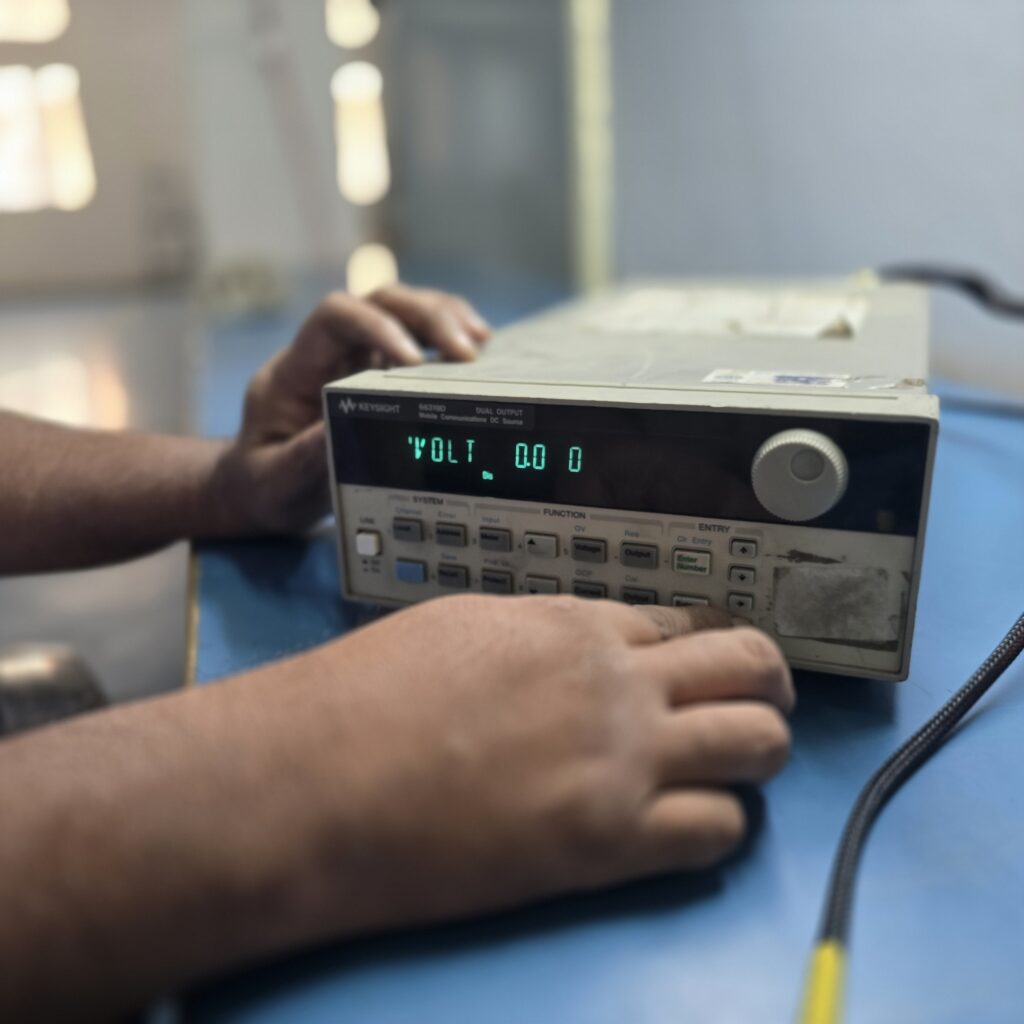
Keysight 66319D mobile communications DC source
Dual output, with built-in DVM input.
- Main output: 0 to 15 V, 0 to 3 A, 5 A peak for up to 7 ms; programmable output resistance
- Auxiliary output: 0 to 12 V, 0 to 1.5 A, 2.5 A peak for up to 1 ms
- Current measurement ranges down to the microamp level, with waveform capture up to 64,000 samples per second
- Remote programming over GPIB (SCPI)
Used for: powering a phone, wearable or IoT device like a battery, and logging its current drain.
Keithley 2306 dual-channel battery/charger simulator
- Two channels, each 0 to 15 V; channel 1 is the battery simulator with programmable output resistance 0 to 1 ohm, channel 2 is the charger simulator
- Battery channel can sink current like a discharged battery (up to 3 A continuous, per datasheet derating)
- Current readback on a 5 A range and a 5 mA range; pulse current measurement for pulses from 60 microseconds
- Built-in digital voltmeter; remote programming over GPIB (SCPI)
Used for: testing chargers and charging circuits, and powering devices with fast-changing current.
Instrument ratings are manufacturer ratings from the datasheets. The right voltages, currents, limits and duration for your product come from your product specification or your own test plan. Keysight and Keithley are trademarks of their respective owners. Star Automations is not affiliated with them.
Who we test for
Wearables, TWS earbuds, smartwatches and smart rings
Sleep current, burst current and run-down profiles.
IoT sensors, modules and gateways
Sleep and wake current profiling for battery-powered devices.
Vehicle trackers and telematics devices
Current in sleep, tracking and transmit states, and backup-battery charging checks.
Chargers, adapters and power banks
Charger and charging-circuit testing against a simulated battery.
Battery and BMS teams, low voltage only
Protection-board bench checks inside 15 V. We do not work on high-voltage EV battery packs.
Mobile phone and electronics repair and refurbishment
Post-repair power check with a record.
Contract manufacturers and electronics start-ups
Overflow, validation and sample testing.
Smart meters, drones, colleges and labs
By enquiry.
Ways to work with us
- Outsourced characterisation at our Bengaluru lab: current profiling and battery-life testing of samples or batches.
- Charger and charging-circuit validation: a defined set of battery voltages and load points, with a record.
- Production overflow and end-of-line power checks: extra capacity when your own bench is busy or down.
- Post-repair test record: for repaired or refurbished phones, devices and boards.
- On-site testing in Bengaluru: we bring the instruments to your premises.
- On request: annual testing contracts, test-fixture and test-script setup, and team training.
How it works
Send the details
Product type, quantity, battery voltage, expected current in each state, and your test limits or specification. Ship samples to us or book an on-site visit in Bengaluru.
Agree the test plan
We confirm in writing the supply voltage and output resistance, the device states to be measured, the duration, the limits and the connections, and tell you if your product is outside our range.
Test
Trained staff run each unit in a supervised area. Every unit is tested and logged individually.
Receive the record
You get a test record with the set conditions, the measured values, the graph or log where available, and a pass or fail result.
What we need from you: the device or board, a way to put it into each test state (test firmware or a test mode), a battery connector or fixture, and your limits. We can sign an NDA on request.
What you receive
A test record (PDF) that lists, for each unit:
- Unit ID or serial number
- Supply conditions: voltage, output resistance, current limit
- Measured current per device state, with average, peak and baseline where measured
- The current-versus-time graph or a data file, where available
- For charger tests: battery voltage points and measured charge current
- Pass or fail against the limits you supplied
- Instrument model used, test date and operator name
Logged data files, photos and remarks can be added on request. We run the test you specify. We do not interpret compliance with a standard for you.
SAMPLE FORMAT (illustrative values, not real data)
| Field | Sample entry |
|---|---|
| Unit ID | SAMPLE-001 |
| Supply setting | XX.X V, output resistance X.XX ohm, current limit X.X A |
| State: sleep | Average XX.X uA, limit XX uA, result PASS or FAIL |
| State: connected idle | Average XX.X mA, limit XX mA, result PASS or FAIL |
| State: transmit burst | Peak XXX mA, burst width XX ms, result PASS or FAIL |
| Overall result | PASS or FAIL against customer limits |
| Instrument, date, operator | Model name, DD-MM-YYYY, operator name |
What we do and do not do
| In scope | Out of scope |
|---|---|
| Low-voltage devices and chargers inside 15 V and our current ratings | High-voltage EV battery packs |
| Current profiling in sleep, idle and burst states | RF, EMC and protocol testing |
| Charger and charging-circuit tests against a simulated battery | Cycle-life, thermal and abuse testing |
| Post-repair bench power checks | BIS, CE, AIS-140 or other certification |
Battery and charger testing is hazardous. We test only low-voltage devices, with trained staff in a supervised area, with sources isolated and de-energised between steps, and with an emergency cut-off. We never leave Li-ion cells charging unattended. We do not work on high-voltage EV battery packs. We do not give unsafe energising instructions, and we do not rent out or hand over the instruments. Please do not attempt this testing without proper training.
Why Star Automations
- 25+ years in industrial electronics repair and testing.
- We repair the electronics we test: drives, servo drives, power supplies and control boards, and we check the power behaviour of a repaired board before it goes back.
- Locations: Pondicherry, Chennai, Bengaluru, Hyderabad and Delhi. Battery drain and charger testing is offered from our Bengaluru office: 1st Floor, 40, Goshala Rd, Garudachar Palya, Mahadevapura, Bengaluru, Karnataka 560048.
- Related repair work: servo drive repair and industrial electronics repair.
- Also need other test services in Bengaluru? See our electronic load testing service for power supplies, SMPS and batteries under load, and our hipot and insulation resistance testing service for electrical safety checks.
- Wi-Fi or Bluetooth device or module? See our wireless connectivity RF testing service in Bengaluru.
Frequently asked questions
What is battery drain testing?
Battery drain testing measures how much current a battery-powered device draws in each state, such as sleep, idle, connected and transmitting, so you can see where battery life is lost. We power the device from a battery simulator, log current over time, and report average, peak and baseline values against your limits.
What is a battery simulator and why use it instead of a real battery?
A battery simulator is a programmable supply that behaves like a battery, with a set voltage and output resistance and a fast response to sudden current bursts. It gives repeatable results without cell ageing or charge-level variation, and lets us step voltage to check cut-off behaviour. It complements real-battery life tests, it does not replace them.
What voltage and current limits can you test?
Our instruments source up to 15 V. Per manufacturer datasheets, the 66319D main output is rated 0 to 3 A with 5 A peak, and the 2306 sources up to 5 A, power-limited, with current readback down to 0.1 microamp resolution. Anything above 15 V, such as e-bike or EV packs, is outside our range.
Can you test TWS earbuds, smartwatches, trackers and IoT devices?
Yes, within our instruments' range. Single-cell and low-voltage devices such as earbuds, smartwatches, rings, GPS trackers and IoT sensors can be powered from the simulator while we record sleep, idle and burst currents. You supply the device with a test mode or firmware and your set conditions. We do not do RF, EMC or protocol testing.
Can you test chargers and charging circuits?
Yes, within range. The battery channel acts as a discharged battery that sinks current, while the second channel can act as the charger source, so we can test chargers and charging circuits over a range of battery voltages and record the results. The charger output must fit within 15 V and our current ratings.
Do you test BMS protection boards and battery packs?
Within our range, we can run bench threshold and current checks on low-voltage protection boards, with feasibility confirmed for each board and a supervised test area. We do not work on high-voltage EV battery packs, and we do not do cycle-life, thermal or abuse testing. Those need a specialist or accredited laboratory.
Can you verify phones and electronics after repair?
Yes. After repair, we can power the device from the simulator and record its current in off, standby and active states, then compare it with your reference limits or a known-good unit. You receive a test record for each unit. It is a bench power check, not a full functional or RF test.
Are your test records NABL or BIS certified?
No. We provide in-house electrical testing and a test record for design checks, production, validation and post-repair checks. We are not a NABL-accredited or BIS-recognised laboratory, and our records do not replace accredited reports. For certification or BIS registration, please use a NABL- or BIS-recognised laboratory.
What do I receive after testing?
You receive a test record, usually a PDF, listing for each unit the set conditions, the measured voltage and current values, the logged graph or data file where available, and a pass or fail result against the limits you gave us. It also shows the instrument model used, the test date and the operator name.
Do you do RF, EMC, AIS-140 or BIS certification testing?
No. Our service is electrical power and current testing. RF, EMC, AIS-140, BIS, CE and similar approvals need notified or accredited laboratories. Our records can support your own design and pre-compliance checks, but they do not replace an accredited report or a certificate.
Who performs the testing?
Our trained staff run every test, at our Bengaluru facility or at your premises, in a supervised area with sources isolated between steps. We do not rent out or hand over the instruments, because battery and charger testing carries fire and shock risk. You send the devices or we visit, and you receive the test record.
How do I request a test?
Send the product type, quantity, battery voltage, expected current in each state, your test limits and whether you need lab, on-site or overflow testing on WhatsApp at +91 97866 22233 or through the enquiry form at www.starautomations.com. We agree a written test plan before any unit is tested.
Get a test plan
Tell us what you need to test: product, quantity, battery voltage, expected current in each state, and your limits or specification.
WhatsApp: +91 97866 22233. Website: www.starautomations.com. Address: 1st Floor, 40, Goshala Rd, Garudachar Palya, Mahadevapura, Bengaluru, Karnataka 560048.
Message received
Our team replies by email or WhatsApp. For urgent requests, WhatsApp +91 97866 22233.
Star Automations provides in-house testing and test records. We are not a NABL-accredited or BIS-recognised laboratory. Star Automations is an independent multi-brand repair company and is not an OEM service centre.