
Bengaluru · Electrical safety testing
Hipot & Electrical Safety Testing Service in Bengaluru
Star Automations runs AC and DC hipot (withstand) and insulation resistance tests from our Bengaluru office in Mahadevapura. You get a test record for every unit: the voltage applied, the current limit, the duration and a pass or fail result. Use us for pre-compliance checks, production overflow, post-repair checks, or on-site testing.
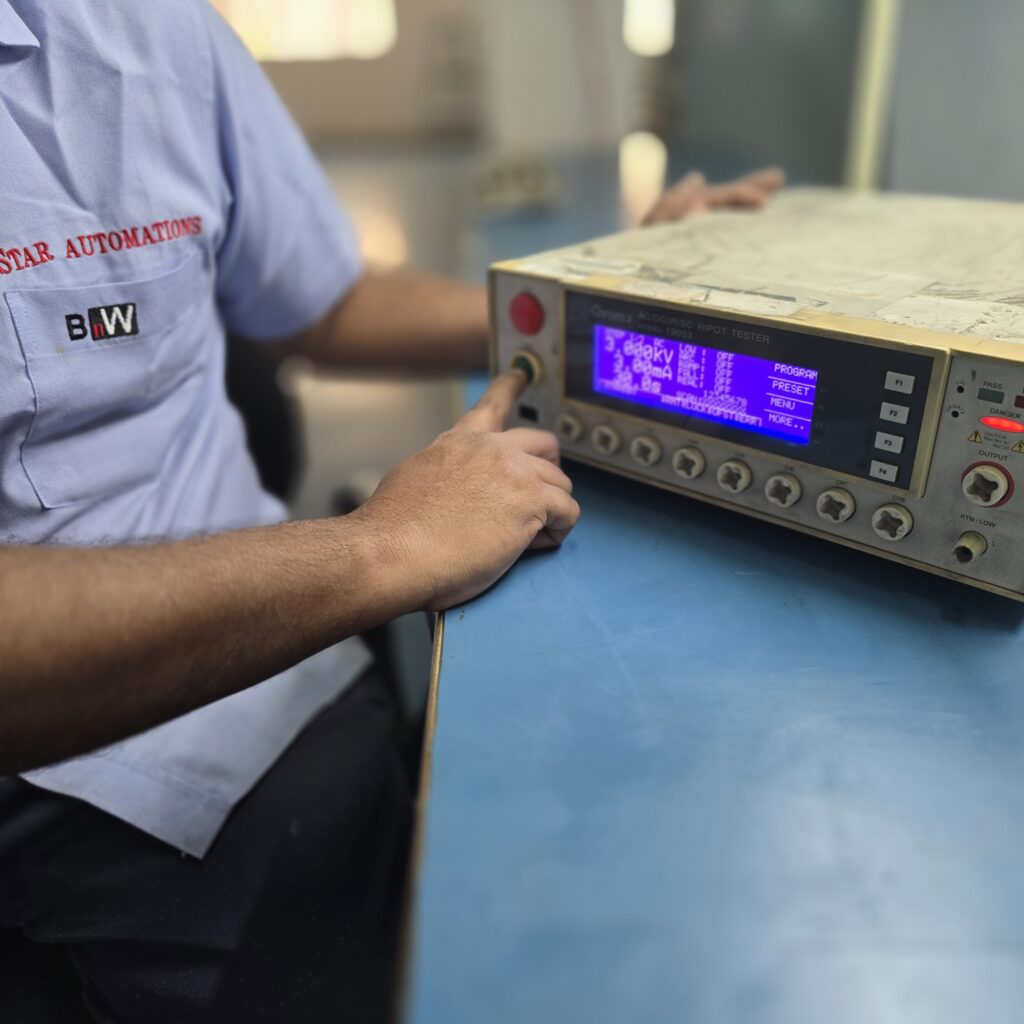
Important: This is an in-house electrical safety test and test record service for pre-compliance, production and post-repair testing. It is not NABL-accredited testing, and it is not BIS or CE certification. Our records do not replace a certified laboratory's report. For accredited certification, please use a NABL- or BIS-recognised laboratory.
What is a hipot test?
A hipot (high-potential) test applies a voltage much higher than normal operating voltage between live parts and accessible metal, usually the chassis or earth, for a set time. The tester watches the leakage current. If the insulation holds with no breakdown, arc or excess current, the unit passes.
An insulation resistance (IR) test is a companion check. It applies a lower DC voltage, up to 1 kV on our instruments, and measures the resistance of the insulation in megohms or gigohms. Hipot tells you whether the insulation can withstand stress; IR tells you the condition of the insulation.
Tests and instruments
| Test | What it does | Our instruments |
|---|---|---|
| AC withstand (hipot) | AC voltage from 0.05 to 5 kV, with a programmable current limit and arc detection | Chroma 19052, 19053, 19073 |
| DC withstand (hipot) | DC voltage from 0.05 to 6 kV; useful for capacitive products | Chroma 19052, 19053, 19073 |
| Insulation resistance | 0.05 to 1 kV DC, resistance readout | Chroma 19052, 19053, 19073 |
| Multi-point scanning | 8-channel high-voltage scanner for multi-pin products such as harnesses and multi-way connectors | Chroma 19053 |
| Other safety tests (ground bond or earth continuity, leakage current, others) | Available on request; we confirm for your job | On request |
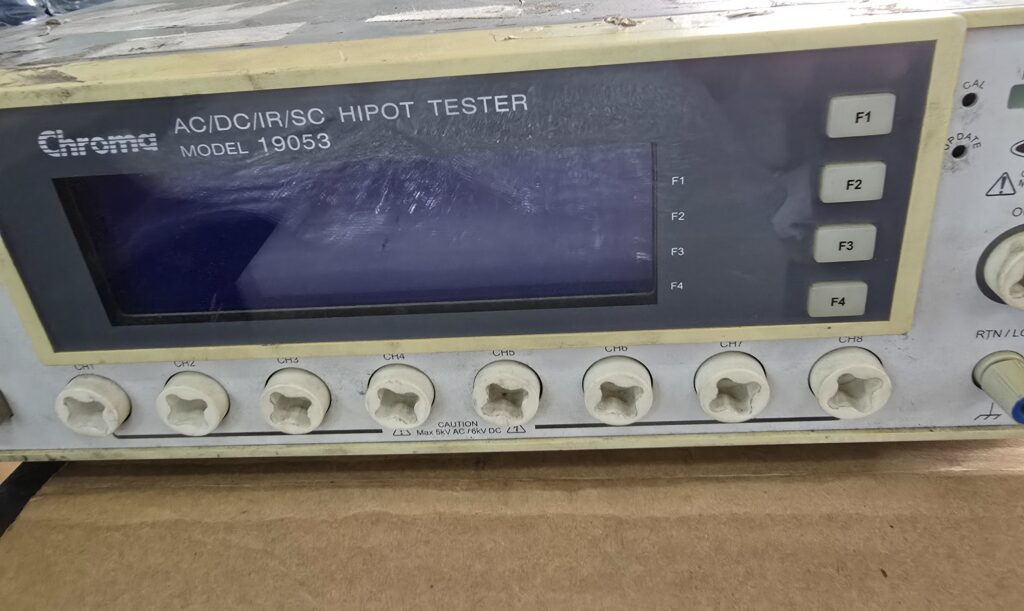
Ranges are from the Chroma 19050 and 19070 series datasheets. The right test voltage, current limit and time for your product come from your product standard or your own test specification.
Who we test for
EV battery packs, chargers and BMS
Insulation and withstand checks before a certified-lab slot, and per-batch checks later.
Power supplies, SMPS, adapters and LED drivers
Primary-to-secondary and primary-to-earth testing.
Contract manufacturers and EMS
Overflow testing when your end-of-line tester is busy, and test fixtures for new products.
Industrial control panels, VFDs and servo drives
Pre-dispatch and post-repair insulation checks.
Data-centre equipment
Low-voltage PDUs, power cords and whips, PSU modules, busbar sections, UPS and battery cabinets.
Repair and refurbishment shops
A documented safety check after repair.
Other equipment
Appliances, lighting, medical electronics, transformers, cable and harness makers, solar inverters and UPS assemblers, telecom hardware, defence and drone electronics: by enquiry.
How it works
Sample intake
Send us the product type, quantity, test specification and the voltage and current limit you need. Ship samples to us or book an on-site visit in Bengaluru.
Test plan
We agree the test type (AC, DC, IR or a combination), voltage, current limit, duration and where to connect, in writing, before testing.
Test
Trained staff run the test with interlocks and a discharge procedure. Every unit is tested and logged individually.
Report
You receive a test record, with unit ID, applied voltage, current limit, duration, measured value and pass or fail.
What you receive
A test record (PDF) that lists, for each unit:
- Unit ID or serial number
- Test type (AC withstand, DC withstand, insulation resistance)
- Applied voltage and current limit
- Test duration
- Measured leakage current or insulation resistance
- Pass or fail
- Instrument model used, test date and operator name
Photos and remarks can be added on request.
Ways to work with us
- Batch testing at our lab: per-unit testing of samples or batches.
- On-site testing in Bengaluru: we bring the tester to your premises for heavy or hard-to-move equipment.
- Production overflow: outsourced end-of-line hipot when your own tester is busy or down.
- Pre-compliance testing: check insulation before you book a BIS or CE laboratory.
- Post-repair safety testing: a test record for repaired or refurbished equipment.
- On request: annual testing contracts, test-fixture and test-program setup (including multi-pin scanning), and hipot safety training for your team.
Safety first
High-voltage testing is hazardous. We test only with trained staff, with interlocks and a discharge procedure after every test. We do not give unsafe energising instructions, and we do not rent out or hand over testers. Our staff carry out every test for you. Please do not attempt hipot testing without proper training and a safe test area.
Why Star Automations
- 25+ years in industrial electronics repair and testing.
- Locations: Pondicherry, Chennai, Bengaluru, Hyderabad and Delhi. Hipot testing is offered from our Bengaluru office: 1st Floor, 40, Goshala Rd, Garudachar Palya, Mahadevapura, Bengaluru, Karnataka 560048.
- Also need load testing of a power supply, charger or battery? See our electronic load testing service in Bengaluru.
- Battery-powered device or charger? See battery drain and charger testing, or all our testing services.
- Related repair work: servo drive repair and industrial electronics repair.
- Wi-Fi or Bluetooth device or module? See our wireless connectivity RF testing service in Bengaluru.
Frequently asked questions
What is a hipot test?
A hipot (high-potential) test applies a voltage far above normal operating voltage between live parts and accessible metal for a set time, while monitoring leakage current. If the insulation holds without breakdown or excess current, the unit passes. It is a safety check of insulation, not a performance or functional test.
What is the difference between AC and DC hipot testing?
AC hipot applies an alternating voltage and stresses insulation in both polarities, so it is common in product standards. DC hipot applies a steady voltage and draws less current on capacitive products such as long cables or filter-heavy equipment. Which one to use depends on your product standard or test specification.
How is insulation resistance (IR) testing different from a hipot test?
An insulation resistance test applies a lower DC voltage, up to 1 kV on our instruments, and measures resistance in megohms or gigohms. A hipot test applies a much higher voltage and checks for breakdown. IR shows insulation condition; hipot checks it can withstand electrical stress. Many procedures use both.
What voltage and current can your testers apply?
Our Chroma 19052, 19053 and 19073 testers apply AC withstand voltage from 0.05 to 5 kV and DC withstand from 0.05 to 6 kV, with insulation resistance testing at 0.05 to 1 kV DC, per Chroma datasheets. The voltage and current limit for your product come from your specification, not from the instrument.
Are your test records NABL or BIS certified?
No. We provide in-house electrical safety testing and a test record for pre-compliance, production and post-repair checks. We are not a NABL-accredited or BIS-recognised laboratory, and our records do not replace accredited reports. For certification or BIS registration, use a NABL- or BIS-recognised laboratory.
What do I receive after testing?
You receive a test record listing each unit, the test type, applied voltage, current limit, test duration, measured current or insulation resistance, and pass or fail result, along with the instrument model used and the test date. We share it as a PDF. Photos and extra remarks can be added on request.
Can you test at our premises in Bengaluru?
Yes, on-site testing at customer premises in Bengaluru can be arranged for equipment that is hard to move, subject to site safety conditions: a clear test area, an isolated and discharged unit, and trained staff. Share the equipment type and specification first, so we can confirm feasibility before visiting.
Who performs the testing?
Our trained staff perform every test, at our Bengaluru facility or at your premises, using interlocks and a discharge procedure after each test. We do not rent out or hand over hipot testers, because high-voltage testing is hazardous. You send the units or we visit, and you receive the test record.
Do you test EV battery packs and chargers?
We can run withstand and insulation resistance checks on EV battery packs, chargers and BMS or controller assemblies within the instrument range of 5 kV AC, 6 kV DC and 1 kV IR. Full type approval, thermal or cycling tests and AIS-156 certification need an accredited laboratory.
Can you test data-centre equipment?
We can do hipot and insulation resistance checks on low-voltage data-centre equipment such as rack PDUs, power cords and whips, PSU modules, busbar sections and UPS or battery cabinet insulation. We do not perform medium-voltage cable VLF testing or testing of installed high-voltage cabling.
Do you test repaired or refurbished equipment?
Yes. After repair or refurbishment, we can run a withstand and insulation resistance check and issue a test record for each unit. This helps confirm that insulation is intact before equipment returns to service. It does not replace the manufacturer's full type tests or any accredited certification.
How do I request a test?
Send us your product type, quantity, test standard or specification, and the required voltage and current limit on WhatsApp at +91 97866 22233 or through the enquiry form at www.starautomations.com. We review the details, agree a test plan with you, and then you send samples or we arrange an on-site visit.
Get a test plan
Tell us what you need to test: product, quantity, standard or specification, voltage and current limit.
WhatsApp: +91 97866 22233. Website: www.starautomations.com. Address: 1st Floor, 40, Goshala Rd, Garudachar Palya, Mahadevapura, Bengaluru, Karnataka 560048.
Message received
Our team replies by email or WhatsApp. For urgent requests, WhatsApp +91 97866 22233.
Star Automations provides in-house safety testing and test records. We are not a NABL-accredited or BIS-recognised laboratory. Star Automations is an independent multi-brand repair company and is not an OEM service centre.