Servo motor repair in India
Bearings, brakes, encoder alignment and load test.
Servo motorsSince 2000 · 3,000+ customers

Rotor and impeller balancing
Star Automations dynamically balances motor rotors, blower and fan impellers, pump impellers and other rotating parts in-house, in horizontal and vertical set-ups, for parts up to about 100 kg. The part is spun, the unbalance is measured in each correction plane, weight is added or removed, and the part is run again until the residual unbalance is inside the tolerance for its speed and duty. Balancing is part of every motor rebuild where the rotor is disturbed, and it is also offered as a separate job for parts you send us.
Unbalance shows up as vibration at the running speed. It is often the reason bearings keep failing a few months after they were changed.
Pressing bearings, repairing a journal or straightening a shaft can shift the mass of the rotor. Changing bearings without checking balance treats the symptom, not the cause.
Winding work, re-varnishing or repairing a rotor adds or moves mass. The rotor must be balanced again before it goes back.
Dust build-up, corrosion or a damaged blade makes an impeller heavy on one side. The vibration grows until the bearings, housing or mounting fail.
A new cooling fan, pulley or coupling half adds its own unbalance to the assembly.
Send the part on its own or fitted to its shaft. Tell us the running speed and, if you have it, the balance grade on the drawing.
We balance in both horizontal and vertical set-ups, for parts up to about 100 kg. Diameter and length are handled with supports and fixtures made to suit the part.
If your rotor or impeller is larger, heavier or an unusual shape, send the details anyway. We adapt the tooling and set-up to the job rather than turning it away.
The impeller runs on the stand while the balancing software reads the sensor. The polar plot shows the unbalance as a weight and an angle, against the tolerance set for the part, here 0.2350 g.
After correction the reading falls inside tolerance and the software shows Balanced. A separate handheld vibration tester on the stand is then used as a cross-check while the impeller runs again.
What it tells you: the result is measured by software against a set tolerance and checked again with a separate instrument. It is not a visual or hand-feel check.
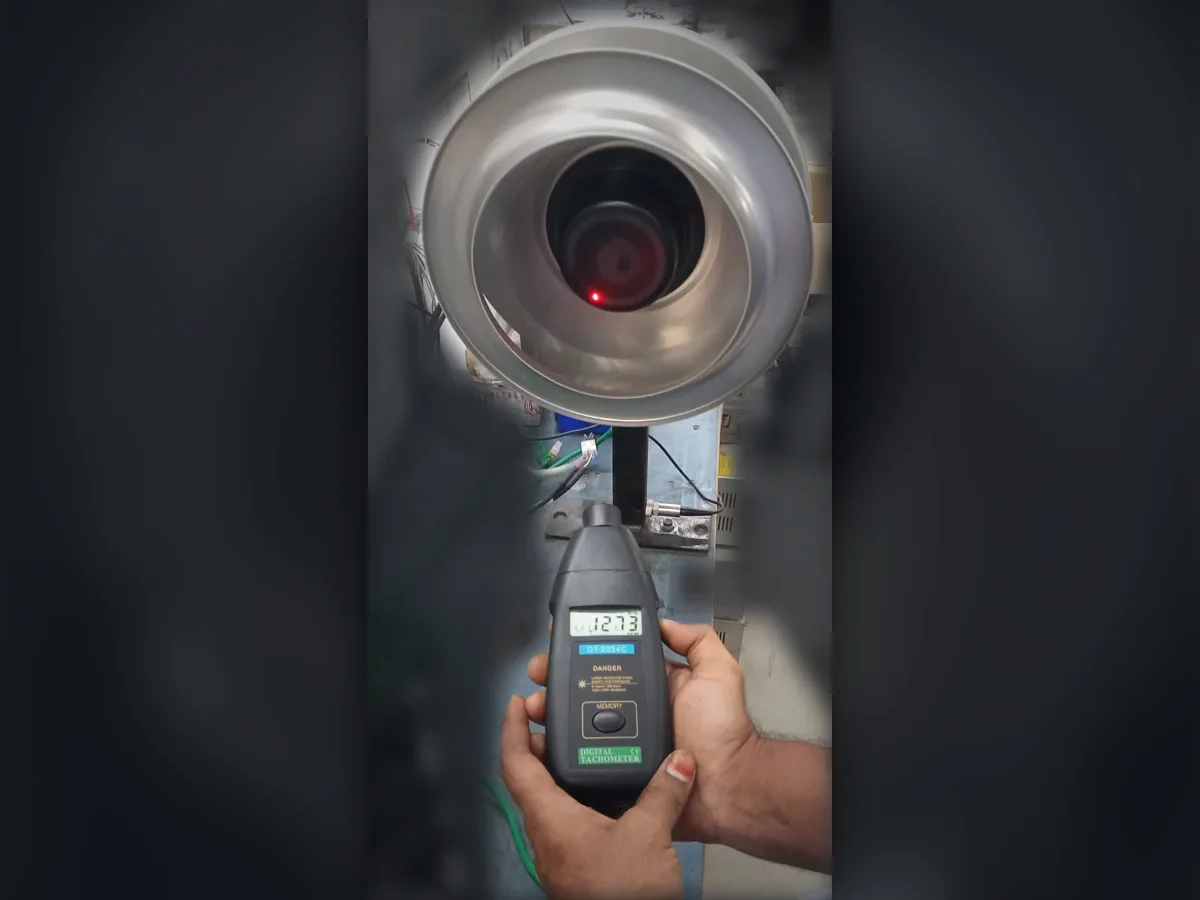
The impeller is spun on the balancing stand. A vibration sensor on the stand picks up the unbalance and shows how much and where, and a hand tachometer confirms the speed, here 1,273 rpm.
Weight is corrected at the indicated angle and the impeller is run again until the reading is inside tolerance.
What it tells you: the part was measured and corrected on a machine, not judged by hand. The before and after readings go on your report.
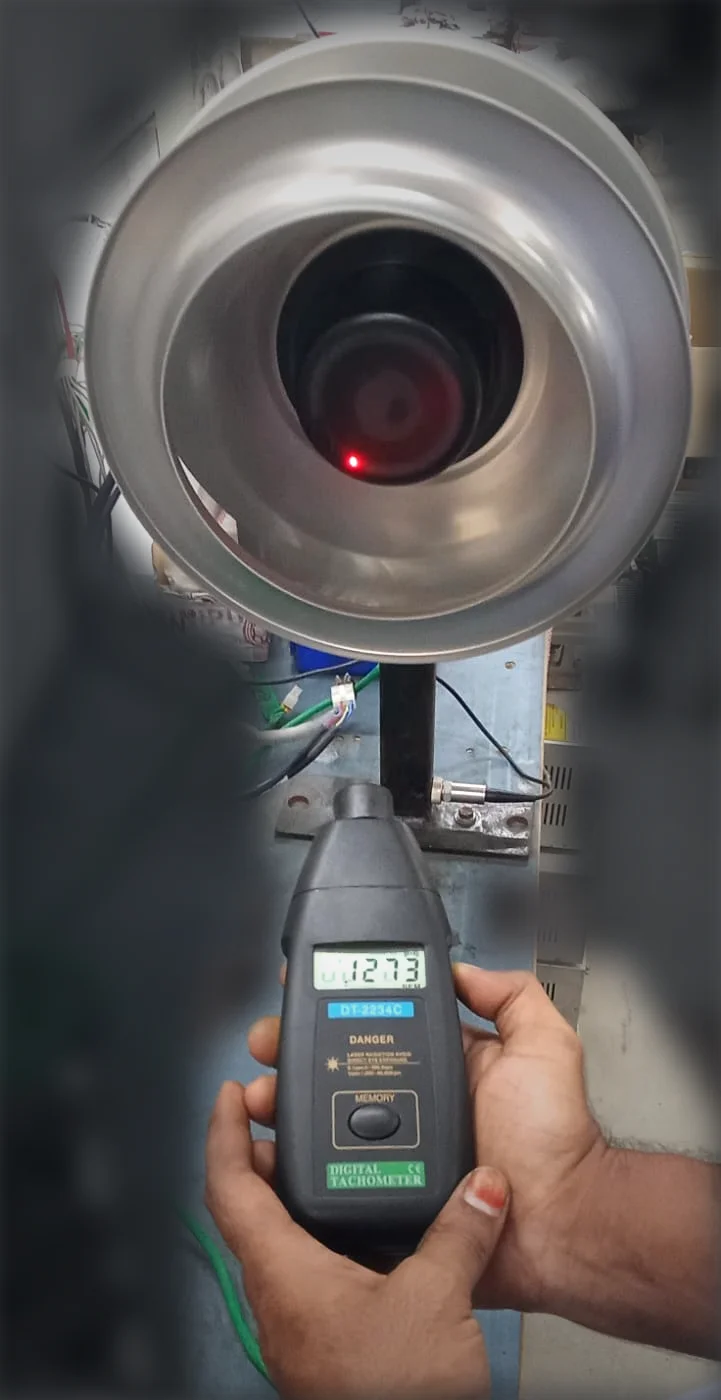
The same sequence for every part, with the readings recorded before and after correction.
The part is checked for cracks, loose parts and build-up, and cleaned so the reading reflects the part, not the dirt on it.
The part is mounted on the balancing machine and spun at a balancing speed suited to its size.
The machine shows how much unbalance there is and where, in one plane for narrow parts or two planes for long rotors.
Weight is added or removed at the indicated angle, by drilling, grinding or fitting balance weights, depending on the part.
The part is run again until the residual unbalance is within tolerance. The before and after readings go on the report.
The balance grade (ISO 21940-11, formerly ISO 1940-1) sets how much residual unbalance is allowed for a part's speed. A lower G number means a finer balance. These are the grades usually applied to the parts we see.
| Part | Typical grade | Why |
|---|---|---|
| Fans, blowers and their impellers | G 6.3 | General industrial rotating parts at moderate speed |
| Electric motor rotors, general purpose | G 6.3 | Standard motors in pumps, conveyors and fans |
| Pump impellers | G 6.3 | Same class as other process machinery |
| Small motors with special requirements, machine-tool drives and spindles | G 2.5 | Higher speed and precision, lower allowed vibration |
If your drawing or the equipment maker specifies a grade, send it with the part and we work to it. For finer grades or special requirements, tell us the target and we set up the job to meet it.
| Bearing change alone | Bearing change with balancing | |
|---|---|---|
| Vibration after repair | Unchanged if the rotor was out of balance | Reduced to the tolerance for the part |
| Bearing life | New bearings wear early under the same unbalance | Bearings run without the extra load |
| Evidence | None for balance | Before and after unbalance readings on the report |
| When it is enough | The rotor was in balance and nothing else was disturbed | Any rotor, fan or impeller that was worked on, damaged or dirty |
Fans, blowers, pump impellers and motor rotors with vibration that returns after every bearing change.
Blower and EC fan impellers from air handling units, cleanrooms and data-centre cooling.
Rotors and armatures after winding work, when the shop does not have its own balancing machine.
After-sales repair of returned units, balanced and tested before they go back to the customer.
| Item | Recorded |
|---|---|
| Part | Description, serial or tag number, weight and running speed |
| Planes | Single-plane or two-plane, and the correction radius |
| Initial unbalance | Amount and angle in each plane, as received |
| Correction | Weight added or removed, and where |
| Residual unbalance | Amount in each plane after correction, against the tolerance for the grade |
Static balancing corrects unbalance in one plane and suits narrow parts such as thin fans and pulleys. Dynamic balancing measures and corrects in two planes and is needed for longer rotors, where unbalance at each end can make the rotor wobble even if it looks balanced at rest.
Not always. If the vibration returns after new bearings, or the rotor, fan or shaft was worked on, the rotor should be checked and balanced. Balancing removes the load that wears new bearings early.
Most general-purpose motor rotors, fans, blowers and pump impellers are balanced to grade G 6.3 under ISO 21940-11. Machine-tool spindles and small precision motors usually need G 2.5. Use the grade on your drawing if there is one.
Yes. Send the impeller with its hub, or with its shaft if it is fitted to one, and tell us the running speed.
Yes. Motor repair shops send rotors and armatures after winding work. Each part is returned with its before and after readings.
A photo of the part, its weight and outside diameter, the running speed, and the balance grade if it is specified. WhatsApp it to +91 97866 22233.
WhatsApp a photo of the rotor or impeller, its weight, diameter and running speed to +91 97866 22233, or email info@starautomations.com.