Servo Motor Repair or Replacement? 7 Signs Maintenance Teams Should Check Before Production Stops
A servo motor rarely fails without warning. The trouble is that its warnings compete with everything else on a running line — the alarm that has always been there, the motor that has always run warm, the noises that blend into the plant. So most maintenance teams find out a servo motor was in trouble the same way: the line stops, and someone is asking how fast a repair can happen.
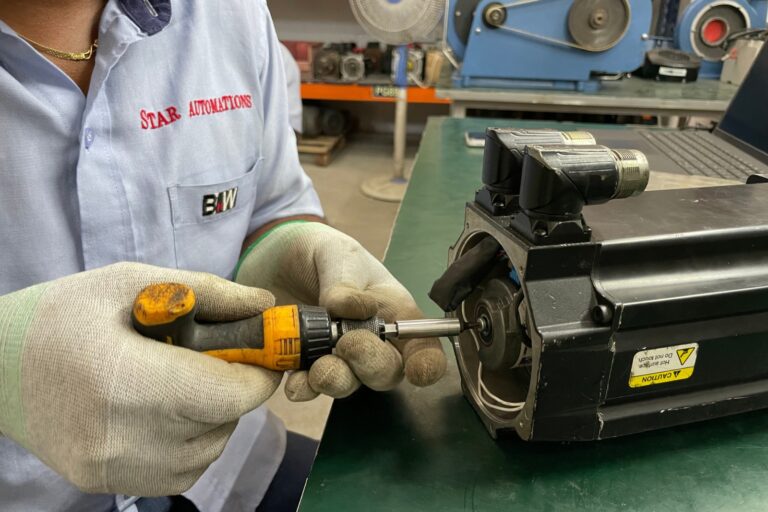
At Star Automations we have repaired, sourced and replaced servo motors and drives for more than 25 years, and the calls follow a pattern. A drive trips repeatedly, or a motor changes its sound, and suddenly the team has to choose between repairing the motor, replacing it with the same model, or moving to something newer. Each option looks reasonable on paper. Each one is wrong in the right circumstances.
This article will not predict when your motor will fail — nobody can do that honestly. It covers seven signs that tell you a motor deserves attention before it forces a decision, and a practical way to weigh repair against replacement while you still have time.
Seven signs worth acting on
1. Abnormal bearing noise. A motor that has run quietly for years rarely gets louder by accident. A rumble, a scrape, or a whine that follows speed points at the bearings — and bearings are the most repairable failure a servo motor has, if you catch them early. Run a failing bearing until it seizes and you can destroy the encoder and the winding in the same event, turning a modest repair into a full replacement.
2. Overheating. Servo motors run hot in normal service, so “it feels warm” is not a fault on its own. A motor that is clearly hotter than it used to be, or that trips on over-temperature more than occasionally, is telling you something. Sometimes the cause is external — a blocked fan, a hot cabinet, a drive pushing the motor past what it was sized for. Sometimes it is internal, and the motor genuinely cannot be trusted. The two cases need different fixes: one is a cleaning and a drive review, the other is a motor change.
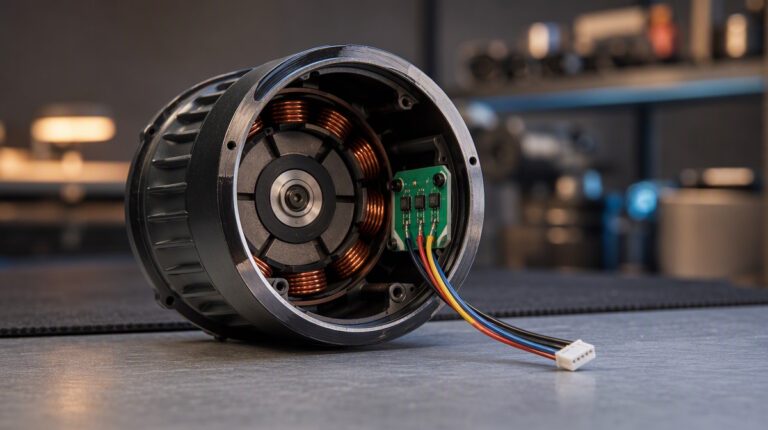
3. Encoder or feedback alarms. When a drive logs a feedback fault, the usual assumption is that the encoder is dead. In many repair cases, the real issue is not the motor alone — it is the feedback cable, a damaged connector, a broken shield, or the coupling between encoder and shaft. The motor itself may be healthy. Chasing a feedback alarm with a replacement motor is one of the most expensive mistakes we see, so test the feedback path before you replace anything. And if the encoder truly has failed, check whether the manufacturer sells it as a spare at all. On some motor families it does not, and that single fact often decides the repair-versus-replacement argument.
4. Brake issues. On a vertical axis the brake is a safety device, and that changes how seriously every symptom should be taken. A brake that drags, fails to release cleanly, or holds intermittently is not a nuisance — it is a reason to take the motor out of service. Brake wear is normal, and brake replacement on an otherwise sound motor is routine. But treat a suspect brake on a suspended load as urgent, and let the motor’s overall condition decide whether the brake job is worth doing at all.
5. Intermittent faults. The hardest faults to diagnose are the ones that will not reproduce. A motor that loses position once a week, faults only when the cabinet is hot, or misbehaves only on a particular shift will send a team in circles. Intermittent faults almost never heal themselves, and they tend to get worse on a curve. Collect the evidence first — fault history, alarm codes, the conditions when it happens. A repair shop can do far more with a fault log and a clear nameplate photo than with “it just stops sometimes.”
6. Repeated drive trips. A drive trips for a reason, and it keeps the record. If the same motor keeps tripping and the drive behaves on a different motor, the motor has earned a bench test — not another reset. On the bench we can see what a running line never shows: current draw, torque behaviour and feedback integrity under controlled conditions. That is when you stop guessing and start deciding whether the motor is worth repairing.
7. Obsolete or unsupported model risk. Sometimes the motor is fine and the problem is the market. When the manufacturer has discontinued the family — increasingly common for servo systems from the 1990s and 2000s — a failure that once meant “order a spare” now means repair what you have, find the last remaining units, or plan a migration. If a critical machine runs a discontinued motor, think about this now, while the motor still works. Waiting turns an orderly decision into an emergency sourcing exercise with production stopped behind it. We source discontinued servo motors and parts as a core part of our work — search the shop for the exact model or send us the part number.
Repair vs Replacement — How to Decide
The repair-versus-replacement decision looks technical. In practice it is mostly commercial, and the honest answer is: it depends — on the motor, on the machine, on your plant. Work through four questions in order.
What failed? Bearings, brakes, cables and connectors are repair territory. A burned winding or a damaged encoder on an obsolete motor often tips the balance toward replacement.
Is the model still supported? A current model can usually be replaced with low risk. A discontinued model cannot — so repair buys you time while you plan a migration, and that changes the arithmetic.
What does the lead time cost? If the line stays down while the motor is away, turnaround matters more than price. If you have a spare unit, cost and reliability dominate instead.
What does a wrong guess cost? A repaired motor that fails again costs you twice. Ask a repair shop how they test before they return a motor, not just how much they charge — testing under load is the difference between a repair and a gamble.
We repair servo motors and drives, and we also source replacement and discontinued units, so we have no reason to push you toward either answer. The recommendation depends on the specific motor — which is why the first step is always the same: send us the model and what happened.
When should you inspect before failure?
The honest answer is: before the motor gives you a reason to. Servo motors rarely get scheduled attention the way gearboxes do, because they run until they do not. That policy works until it fails.
After any unexpected drive trip, give the axis a quick look before you reset and forget it. When a machine is down for any other reason, add the servo axis to the job list while it is accessible — a five-minute look costs nothing when the line is already stopped. And use planned shutdowns for the checks that need the motor stopped: bearing feel, brake function, connector condition, feedback cable routing.
If you do not track running hours, you are flying blind on age. Our free Servo Health Check compares the usage you enter against verified OEM reference data and tells you whether the motor sits in a range where an inspection makes sense. It is a planning tool, not a crystal ball — it does not predict failure, and where it has no verified data it says so instead of guessing.
Common questions maintenance teams ask
Should I repair or replace my servo motor? It depends on what failed, whether the model is still supported, and how long the machine can wait. Start with the two facts that decide everything else: what the fault actually is, and whether the manufacturer still makes the model. Send us both and we will give you a straight answer.
What are the first signs a servo motor is failing? A change in bearing noise, a higher running temperature than usual, feedback or brake alarms, intermittent faults, and repeated drive trips. Any single one deserves attention; two or more together mean the motor should be checked before it stops on its own.
Can an obsolete servo motor still be repaired? Usually yes, if the failed part can be sourced or rebuilt — bearings, brakes, encoders and cables are routinely replaced on discontinued motors. Repair extends the life of the machine while you decide whether to migrate. When a part genuinely cannot be found, we will tell you plainly, and source or advise an alternative.
How long does a servo motor repair take? Only after we know the fault. Turnaround depends on what failed and whether parts are available, so any shop that quotes a fixed time before diagnosis is guessing. Send the model, the fault code and what happened, and we will give you a realistic estimate.
What do you need from me for a repair or replacement quote? The model and part number from the nameplate — a photo helps — plus the fault code if there is one and a short description of what happened. That is enough to start; we ask for more only if the diagnosis needs it.
Not sure whether to repair or replace your servo motor? Send the model, part number, fault code or nameplate to Star Automations via Ask Star, and a technical person will come back to you. If the motor is still running and you want to know where it stands on age and service, run it through the free Servo Health Check first.