How to Identify the Right Replacement for an Obsolete Industrial Automation Part
When an automation part on a running machine is discontinued, the machine does not stop needing that part. It stops being able to order it from the manufacturer. The practical question for a maintenance team is no longer “can we buy it” — it is “what exactly do we have, and which of the available routes is the safe one: repair, source the same model, or move to a verified replacement?”
This guide is written for maintenance heads, plant heads, engineering managers, maintenance engineers, and OEM and machine-builder teams who need a disciplined, repeatable way to answer that question — without turning a routine replacement into an unplanned line stop. Every step below is about gathering facts first and deciding second.
One rule before anything else: never assume two visually similar automation parts are interchangeable. Two units can look identical, mount the same way, and still differ in supply voltage, feedback device, control firmware, or connector pinout. Visual similarity is not a compatibility check. The only reliable path runs through the part identity and the nameplate data covered in the next sections.
Start with the exact manufacturer and part number
Identification begins with one thing: the full part number or model exactly as the manufacturer printed it. “A Yaskawa servo drive” or “a Siemens PLC module” is not a part number — whole families of drives and modules carry the same brand, and only the complete printed model tells you which one is fitted to your machine.
Record the model exactly as printed, character for character. Suffixes, dashes, and revision letters are not decoration. Manufacturers use them to encode output stage, voltage class, feedback option, firmware generation, and fitted options — change one character and the component can behave differently. Photograph the label if you are not certain you copied it correctly.
Check for secondary labels as well. Many drives carry a separate firmware or software version sticker, and some modules have an additional barcode label with the full order code. The main nameplate alone is often not the complete identity.
Capture the full nameplate before searching
Before you contact anyone — supplier, repair shop, or sourcing desk — capture the complete nameplate. A clear, straight-on photo with the whole plate in frame and no glare is worth more than a paragraph of description. If the equipment has more than one plate (common on motors and on drive-plus-motor pairs), photograph each one. The feedback device on a servo motor carries its own identity and is frequently the deciding detail.
Record these fields where they are printed:
- Manufacturer and full model or part number
- Serial number and any date code
- Rated voltage, current, frequency, and power (kW/HP) where stated
- Control or firmware version, if printed on a label
- For motors: frame size, rated speed, rated torque, and insulation class
- For drives and converters: input ratings and output ratings separately — they are rarely the same
- For PLC and HMI hardware: the exact module or CPU order number and any I/O configuration printed on the unit
- Feedback device type where visible (encoder or resolver type, line count or absolute/ incremental designation)
Each of these fields is a search key. A part number with a clean nameplate photo answers most identification questions before a single engineer opens a manual.
Check voltage, current, power, and control requirements
Matching the part number is not the same as matching the machine. Before any candidate part is treated as a drop-in, its electrical ratings must be compared against the nameplate you captured — not assumed from appearance.
Compare at minimum:
- Supply voltage and phase configuration, including the operating range the unit is rated for
- Rated current and any peak or short-time rating relevant to your duty cycle
- Rated output power for motors and drives
- Control supply requirements where the unit has a separate one
A unit with the wrong supply voltage can fail at first power-up. A current mismatch can mean nuisance trips on one side or an overheated, derated component on the other. These are not cosmetic differences — they are the difference between a running machine and a second failure.
Confirm communication and feedback interfaces where relevant
Automation parts do not work alone; they work as part of a control chain. A candidate part that matches electrically can still be incompatible with the rest of the machine if its interfaces differ.
Check the parts of the chain that matter for your equipment:
- For PLCs and HMIs: the fieldbus or network protocol generation, I/O module type, and how the unit communicates with the rest of the control system
- For servo drives: the feedback device on the motor (encoder type and line count, or resolver) and the command interface from the controller (pulse train, analog command, or bus)
- For any unit: connector and cabling standards between the part and its neighbours
Two functionally similar units from the same brand can belong to different protocol generations. A newer module may physically fit an older rack and still be unable to talk to the rest of the line. Interface confirmation is a separate check from electrical matching, and it is the one most often skipped.
Check physical mounting and connector differences
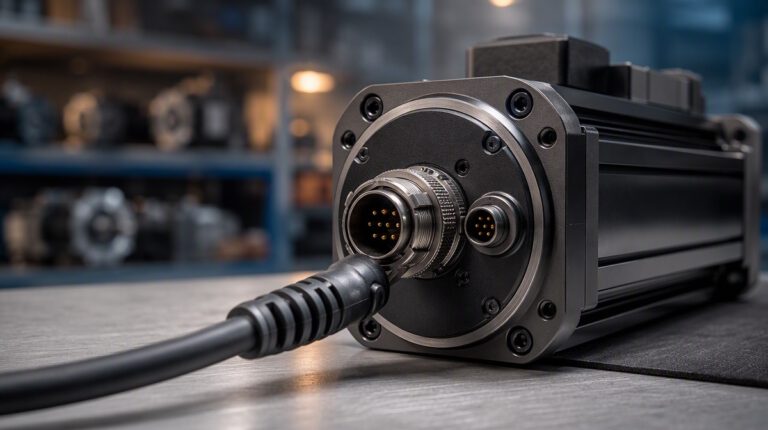
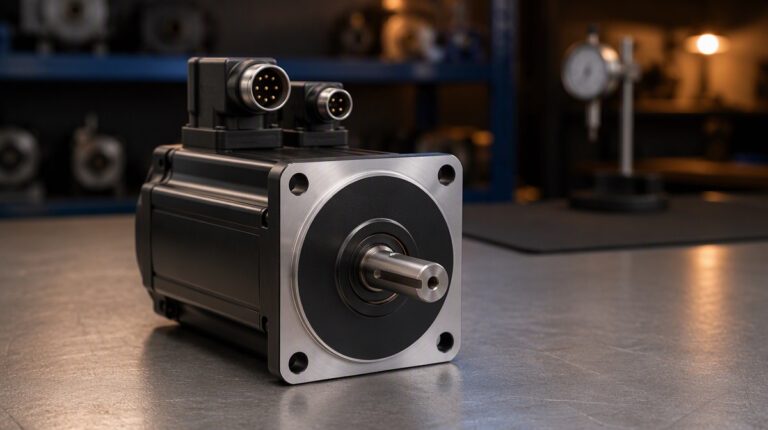
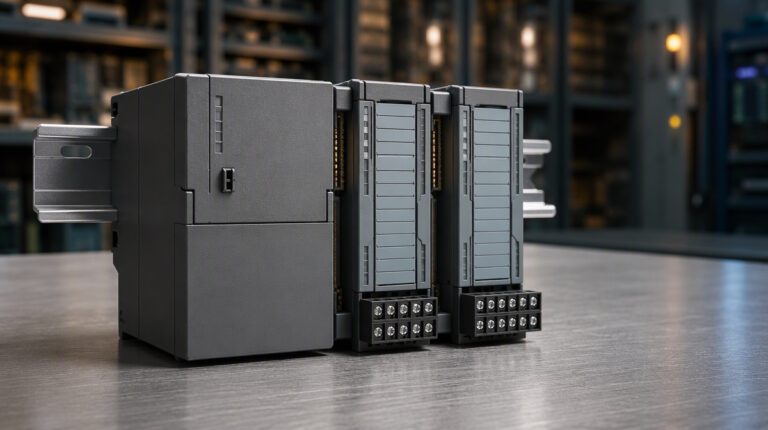
Physical fit is its own check. For motors, compare frame size, mounting flange and bolt pattern, shaft diameter and keyway, and how the motor couples to the gearbox or driven load. For drives and modules, compare panel cutout dimensions, DIN-rail versus panel mounting, connector types, and pinouts — a connector that looks the same can be wired differently.
Clearance matters too: forced-air cooled drives and motors need the same airflow path as the original. A part that fits in every dimension except the one that blocks its cooling is not a fit at all.
Keep electrical fit and physical fit as two separate line items in any evaluation. If both match and the interfaces are confirmed, you have a genuine candidate. If either does not match, you have a modification project, not a replacement — and that changes the risk calculation completely.
Determine whether repair is safer than migration
Repair keeps the machine exactly as it is: same wiring, same feedback scheme, same operator interface, same control program. For a plant that is not ready for a migration, that is the lowest-risk route — provided the fault itself is repairable and the repair is economically sensible.
Repair is usually the practical first route when:
- The machine is otherwise healthy and you are not planning a control upgrade
- The fault is in a repairable area, such as a power stage, capacitors, connectors, feedback device, or bearings
- No verified successor exists, and keeping the installed unit running preserves your existing spares and documentation
- There is no change window large enough for a migration and re-commissioning
Repair has a practical limit: when the failed internal component is itself no longer obtainable, or the same fault repeats after repair, the economics change. That decision needs an evaluation of the actual unit — not a blanket rule. Our servo motor and drive repair and recovery service exists for exactly this evaluation, including units already down on the line.
When sourcing the exact obsolete model makes sense
Sourcing the same model keeps the machine unchanged in every respect — no requalification, no parameter work, no interface questions. That is why an exact-model search is often the right move even when a newer model exists on paper.
An exact-model source makes particular sense when:
- The machine is critical and a change window for re-commissioning does not exist
- You run several identical machines and want spares commonality across the fleet
- Your process or customer validation depends on the machine staying exactly as built
- The migration is planned, but not for years — and the machine must keep running until then
One honest constraint applies to every sourcing search: availability depends on what exists in the market. Discontinued models surface through specialist stockists, surplus inventories, and decommissioned plants, but no supplier can truthfully guarantee a date for a part that may not currently exist anywhere. The practical rule is to start the search before the machine is down. Our critical industrial parts and global sourcing desk works this way for discontinued models across brands — the search begins with your exact part number, and the answer starts with whether the model can be located at all.
When replacement or upgrade is the better route
There are conditions where replacement beats both repair and exact-model sourcing:
- A verified successor exists with documented compatibility for your wiring and feedback scheme
- The unit has failed repeatedly, and the failure pattern points at the design rather than the individual component
- The exact model is no longer obtainable in any market, and repair is no longer viable
- The machine is already scheduled for a control overhaul, so migration cost is shared
- You need manufacturer support and software that only exists for current-generation products
A replacement is not “a newer model of the same brand.” It is an engineering change: supply voltage and current must be re-verified, communication and feedback interfaces re-mapped, parameters re-created, physical mounting re-checked, and safety circuits re-validated. Every identification step in this article feeds that review — which is why the nameplate and interface data you gather first are exactly what a replacement recommendation is built on.
What information Star Automations needs to review the requirement
To review your part — for repair, for exact-model sourcing, or for a replacement recommendation — Star Automations’ technical desk needs the same facts any competent evaluation starts from:
- Manufacturer and exact part number or model, exactly as printed
- A clear, straight-on nameplate photo (one per unit, including the feedback device on motors)
- Rated voltage, current, and power from the nameplate where printed
- Machine and application details: what the part does, what machine it is on, and whether the machine is down or still running
- What you want to achieve: repair evaluation, exact-model sourcing, or a replacement review
- Any manual, cross-reference, or previous repair history you already hold
With those details, the review can state which route is realistic for your specific unit. Without them, any answer is guesswork — and a guess is not a basis for a maintenance decision.
Obsolete automation part questions, answered
How do I find a replacement for an obsolete PLC?
Start with the exact CPU or module order number and a nameplate photo — the printed model, not the family name. Then confirm the bus and protocol generation your rack uses and the I/O configuration you actually need. A successor from the same family is only a candidate if it matches the backplane, protocol, and supply your installation uses; otherwise you are looking at a migration, not a replacement. For legacy programmable controllers where the exact module is discontinued, specialist obsolete PLC replacement and sourcing support is available — starting from the same order number and nameplate.
Can an obsolete servo drive be replaced with a newer model?
In many cases yes, but not automatically. A newer drive is only a true replacement if its supply ratings match your installation, its command interface accepts what your controller sends, its feedback input matches the encoder or resolver on your existing motor, and it physically fits the panel with the same cooling path. Those four checks decide it — which is why servo drive replacement reviews start with the drive nameplate and the motor feedback device, as covered in this article. For Yaskawa SGDM and SGDH series units, repair and sourcing support for the exact series keeps the original drive architecture running where a migration is not wanted.
Is it better to repair or replace discontinued automation equipment?
Repair first when the machine is otherwise healthy, the fault is repairable, and you are not ready for a migration — it keeps wiring, feedback, and the control program untouched. Move to replacement when the unit has failed repeatedly, no verified successor question remains, or the machine is already scheduled for a control overhaul. We published a fuller walk-through of the repair-versus-replace-versus-source decision that pairs with the identification process here.
Can Star Automations source an exact obsolete part?
We work on sourcing discontinued and hard-to-find automation parts across brands through verified supply channels — stockists, surplus inventories, and decommissioned plant. Whether a specific part can be sourced depends entirely on whether that exact model exists in the market today, so the honest first step is a search against your part number and nameplate data. Send those details, and the sourcing desk will tell you whether the model can be located rather than promising a date in advance.
What details are needed for a replacement recommendation?
Five things: the manufacturer, the exact part number, a clear nameplate photo, the machine and application details (including whether the line is down), and your goal — repair, sourcing, or replacement. With those, a review can compare ratings, interfaces, and physical fit against verified options and state which route is realistic for your unit.
Need help identifying a replacement for an obsolete automation part?
Send:
- Manufacturer
- Exact part number
- Clear nameplate photo
- Machine and application details
…to Ask Star for a repair, replacement, or sourcing review. If you would rather look first, browse the shop for verified inventory. Either way, start with the part number — the rest follows from that.