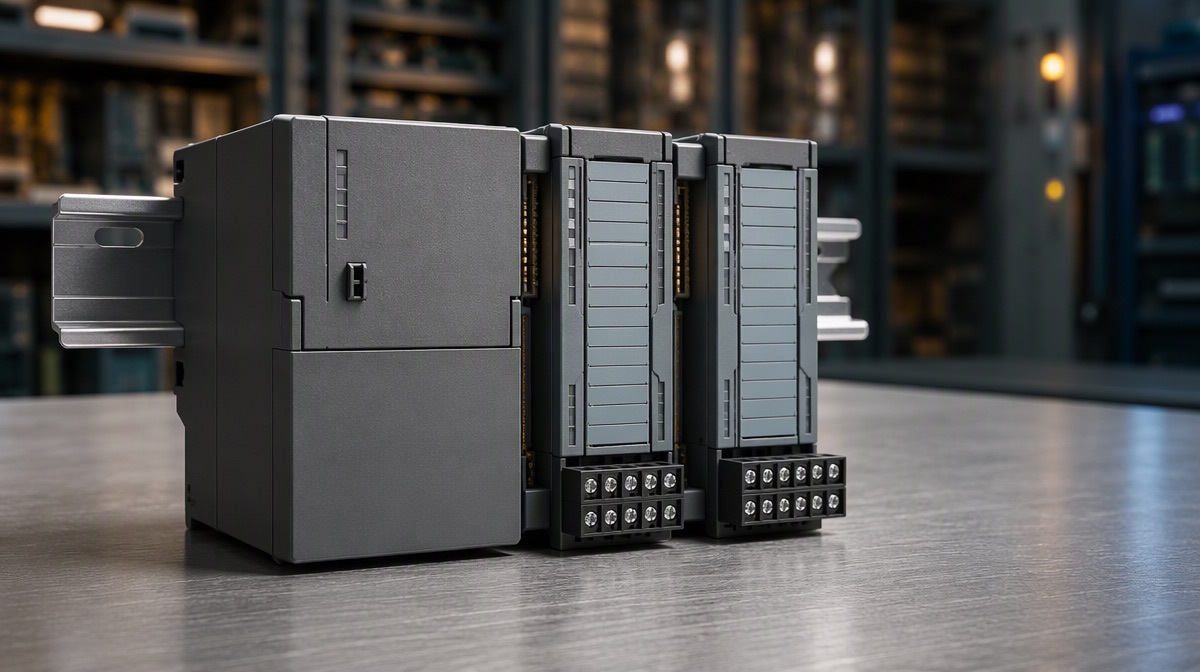
Siemens S7-300 (6ES7): What “Type Cancellation” Means for Plants Still Running It
Siemens’ “type cancellation” for the SIMATIC S7-300 and ET 200M systems took effect on 1 October 2025 (PM410). From that date, those components are no longer sold as new project hardware — they are available only as spare parts, or through repair and exchange, in quantities customary for spares. Siemens’ stated successor direction is the S7-1500 with ET 200MP for factory automation, and the S7-400 with ET 200SP HA for process automation.
That is the short answer. What matters for a plant still running S7-300 hardware is what the milestone does and does not change — because the practical effect is different for a spare-part order, a failed module, and a planned expansion.
What does “type cancellation” (PM410) actually mean?
Siemens publishes a lifecycle milestone for its SIMATIC families. PM400 is the product phase-out announcement: components reach PM400 and are removed from active marketing — they stop being listed in the catalog. PM410 is product cancellation, or type discontinuation: up to that date components are still available as new parts; afterwards, Siemens states they “will only be available as spare parts or can be returned for repair.”
For the S7-300 / ET 200M families, Siemens set PM400 at 1 October 2023 and PM410 effective 1 October 2025. Siemens also notes that for individual components the date can be earlier, and that the phase-out entry is updated as the component market changes.
Source: Siemens Industry Online Support, “Information about the product phase-out of S7-300 / ET 200M components”, entry ID 109809890 (entry date 20 January 2026); and “Upgrade from SIMATIC ET 200M to SIMATIC ET 200SP HA”, entry ID 109809934 (product note, 4 July 2025).
What changed on 1 October 2025 — and what did not?
Three practical changes apply from PM410, in Siemens’ own wording:
- Spare-part quantities only. Components “can only be purchased in a quantity that is customary for spare parts.” Plant expansions and new investments can no longer be supplied on this platform.
- Exchange may be required. Siemens reserves the right to deliver individual components “only in exchange for the defective part.”
- Service requests may be chargeable. Siemens reserves the right to charge for service requests on these products from PM410 onwards.
What did not change: the installed base. Type cancellation is a supply milestone, not a functional one. An S7-300 rack that was running normally on 30 September 2025 kept running on 1 October — and keeps running today, provided spares, repair, or a migration plan are in place.
Repair remains an official channel. Siemens’ phase-out wording explicitly includes returning components for repair, which is why a failed module is not automatically a dead end.
Can you still buy spare parts after type cancellation?
Yes — as spare parts, subject to availability, and no longer as new project hardware. Siemens’ separate ET 200M migration note states the same discontinuation date and adds that, with the announcement of the type discontinuation, “the components will continue to be available as spare parts (planned until October 1, 2033).”
Two qualifications belong with that date, because both are stated by Siemens and both matter for planning: the 2033 date is a plan, not a guarantee; and Siemens warns that individual components may need to be withdrawn from the market earlier than planned.
Availability therefore has to be confirmed per part number rather than assumed from the platform. For a discontinued platform, the realistic routes are a verified spare-part source, a repair or exchange of the failed unit, or a migration — and which one is practical depends on the specific 6ES7 order number.
Source: Siemens Industry Online Support entry ID 109809934, product note dated 4 July 2025.
What happens at PM490 — and when?
PM490 is the final milestone: discontinuation. From PM490, components can no longer be ordered at all, and Siemens states that only warranty cases will be handled — replacement and repair only within the scope of liability for defects.
Siemens has not set a hard calendar date for S7-300 / ET 200M at PM490 in the phase-out entry reviewed here. The entry explains the planning rule instead: product discontinuation is not planned before the expiry of a 10-year period following PM400. With PM400 set at 1 October 2023, that planning horizon points to 2033 — the same year cited in the ET 200M migration note for planned spare-part availability.
This is a planning horizon, not a promise. Siemens explicitly reserves the right to withdraw individual components earlier, which is the reason a whole-platform assumption (“parts will be available until 2033”) is weaker than a per-part-number review.
What are the actual replacement paths for S7-300?
Siemens names functional successors rather than a single drop-in replacement:
- Factory automation: SIMATIC S7-1500 with the ET 200MP I/O system (the ET 200SP is named as an alternative in manufacturing environments).
- Process automation: SIMATIC S7-400 with the ET 200SP HA I/O system.
These are system-level successors, and Siemens recommends moving to them before the milestone pressure arrives. The engineering consequence is the part most often underestimated: migration is not a module swap. Siemens’ own migration material covers module comparison, planning tools and address-range changes, and notes that configurations and programs need conversion work.
That is why a replacement decision on an S7-300 has three genuinely different shapes — source the same 6ES7 part, repair or exchange the failed unit, or migrate the control system — and they are not interchangeable in cost or schedule.
Repair, source, or migrate: how do you decide?
The deciding facts are specific to the installation, not to the platform name:
- What exactly failed. A CPU, a signal module, a communication processor and an interface module carry different sourcing realities, and the 6ES7 order number printed on the module is what drives the search.
- Whether the machine can stay as built. Repair or exchange keeps the existing wiring, program and I/O configuration unchanged, which matters when the line has no window for re-commissioning.
- What the plant’s roadmap is. If a control upgrade is already planned, paying for a stop-gap spare is a different decision than it is on a machine with years of intended service left.
- How many identical units are installed. A fleet of identical racks changes the value of holding matched spares.
Two limits should be stated plainly. Repair is only a route if the failed unit is repairable — that is confirmed per unit, not per model. And sourcing depends on what exists in the market at the time of the search: no supplier can commit to a delivery date for a discontinued module before checking.
We covered the identification discipline behind this in more detail in how to identify the right replacement for an obsolete automation part, and the sourcing side of the same problem in what changed in legacy PLC memory sourcing in 2026.
Siemens S7-300 lifecycle — direct answers
Is the Siemens S7-300 discontinued?
Siemens set the product phase-out announcement (PM400) for 1 October 2023 and product cancellation / type discontinuation (PM410) effective 1 October 2025. After PM410 the S7-300 and ET 200M components are available only as spare parts or for repair/exchange — not as new project hardware.
Can I still get spare parts for an S7-300?
Yes, as spare parts, subject to availability and in spare-part quantities. Siemens’ ET 200M migration note says components remain available as spare parts with planned availability until 1 October 2033, while warning that individual components may be withdrawn earlier. Availability must be confirmed against the exact 6ES7 order number.
What is the successor to the S7-300?
Siemens names the S7-1500 with ET 200MP (and ET 200SP as an alternative) for factory automation, and the S7-400 with ET 200SP HA for process automation. These are system-level successors; migration involves program conversion and hardware redesign, not a drop-in module swap.
Can a failed S7-300 module be repaired instead of replaced?
Repair and exchange remain official channels — Siemens’ phase-out wording includes returning components for repair, and reserves the right to supply some components only in exchange for the defective part. Whether a specific module is repairable is confirmed per unit after inspection.
Can Star Automations source or repair 6ES7 modules?
Star Automations supports S7-300 (6ES7) sourcing, repair and exchange, and migration review. Sourcing is confirmed per request against the exact order number; no stock level or delivery window is claimed in advance.
What does Star Automations need to review an S7-300 requirement?
Send the exact 6ES7 order number printed on the module, the rack or station context if known, the quantity needed, and what the module is doing in the application. If the module has failed, add the fault or alarm behaviour you observed. A photo of the module label is the fastest way to start.
Need an S7-300 module sourced, repaired or exchanged — or a migration review before deciding?
Send the 6ES7 order number and machine details to Ask Star for a sourcing, repair or migration review. If you would rather look first, browse the shop for verified inventory.
Sources: Siemens Industry Online Support, “Information about the product phase-out of S7-300 / ET 200M components”, entry ID 109809890 (20 January 2026). Siemens Industry Online Support, “Upgrade from SIMATIC ET 200M to SIMATIC ET 200SP HA”, entry ID 109809934 (product note, 4 July 2025). Star Automations S7-300 (6ES7) sourcing page. All lifecycle dates and milestone definitions above are Siemens’ published wording; the repair, sourcing and migration commentary is Star Automations’ operational guidance.