Why does a BLDC motor lock and heat when a Hall sensor fails?
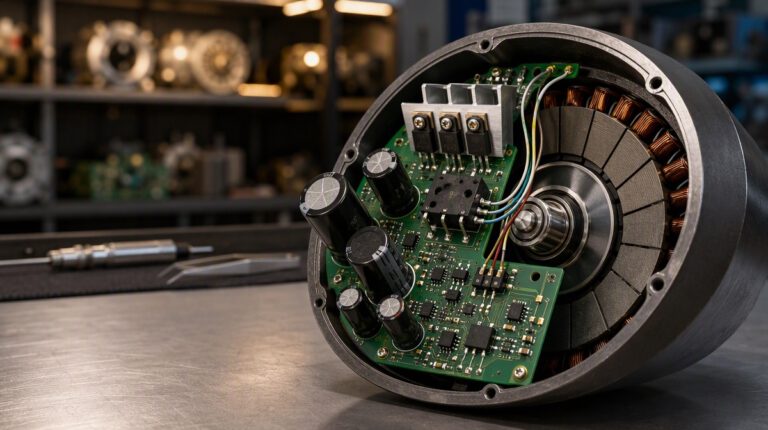
A brushless motor that locks and gets hot is often treated as a controller failure. Usually it is the commutation map. The Hall sensors tell the electronics where the rotor is, and when that information is wrong the drive still switches phases — just at the wrong moment. The result is heat, not torque.
What the Hall sensors actually do
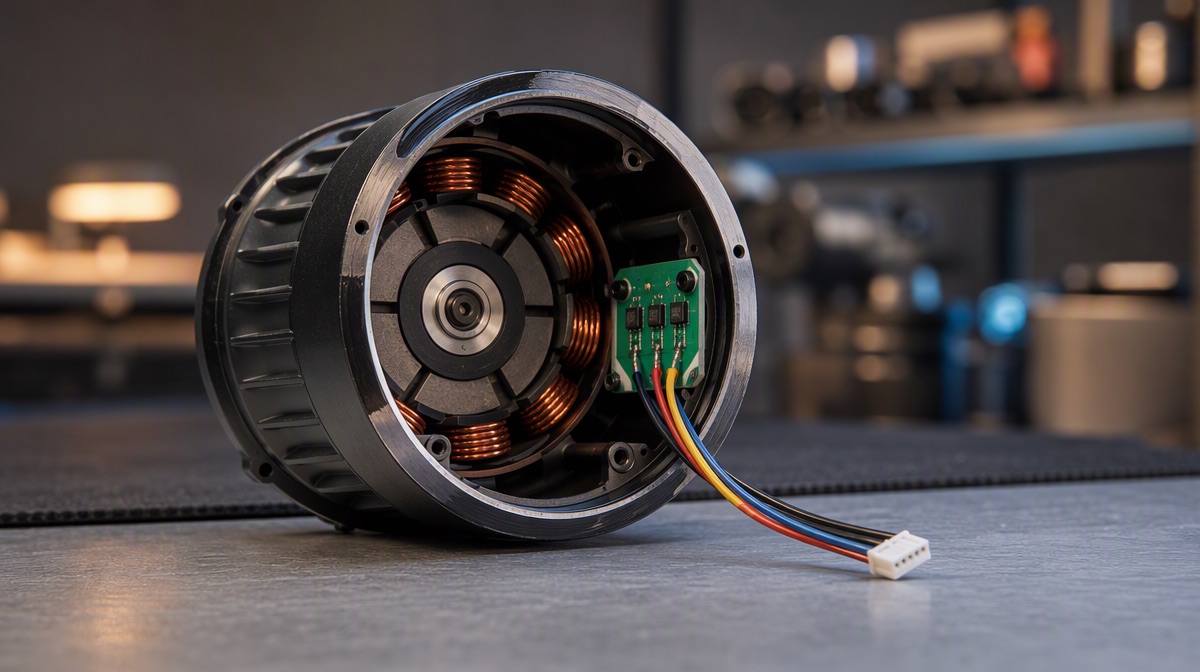
On a BLDC motor the Hall sensors give the electronics rotor position. The controller uses that to decide which phase pair gets current at each moment.
No valid position information means no valid commutation. The motor cannot run properly, however healthy the windings are.
Why it heats instead of stopping
A dead or illegal Hall state can leave current sitting in one phase pair. Current in the wrong pair is heat and no useful rotation. That is why the housing gets hot while the shaft does nothing — and why the winding is often blamed for damage the switching caused.
The illegal states are the ones worth remembering. All three outputs low — 000 — or all three high — 111 — is not a rotor position. It is a fault condition. In a healthy motor you should never see those states while the shaft turns.
Test the Hall rail first
Start with the supply. The Hall sensors run from a 5 V rail, and that rail has to be present before any output means anything. Confirm 5 V at the sensor connector with the meter.
If the rail is missing, the outputs are meaningless and the fault may be upstream in the controller. Fix the rail question before reading channel behaviour.
Then watch each channel move
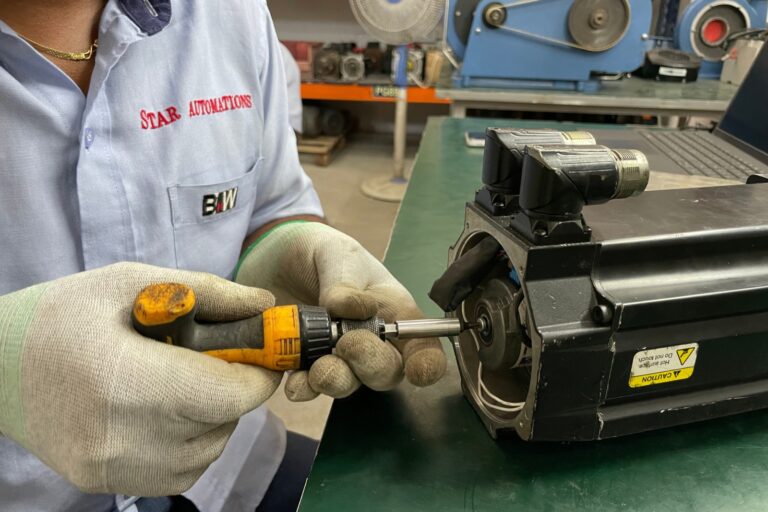
With the 5 V rail confirmed, turn the shaft by hand and watch each Hall output.
- Each channel should swing between 0 V and 5 V as the rotor passes its position.
- The switching should follow the sequence, not repeat at random.
- A channel that never toggles is a fault — sensor, wiring or connector.
- All three sitting in an illegal combination means the same.
This is slow work with a meter and a hand on the shaft. It is also the only way to prove the map before blaming the drive.
The controller is not always the failed part
A perfectly good controller given a bad Hall map will still lock or trip. Test the sensors before the drive is condemned.
The reverse is also true. A controller with a failed input stage will read a good sensor as noise. That is why the sensor test comes first and the drive swap comes second.
Alignment after a swap
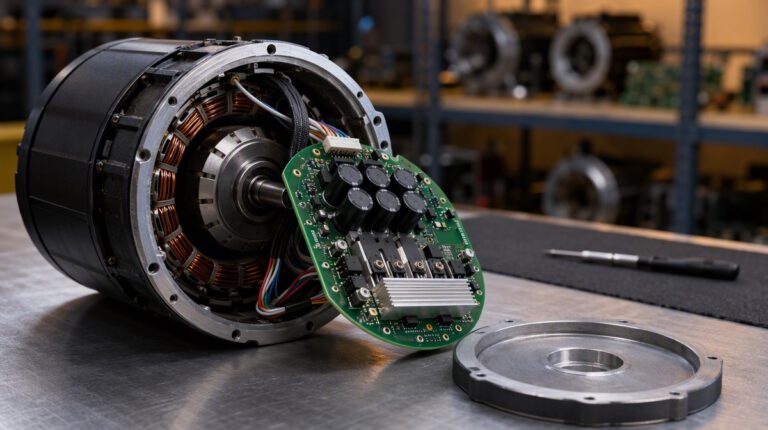
A board or sensor replacement is not finished at the moment the motor spins. Once the electronics are proven live, the Hall position has to line up with the rotor, and the commutation sequence has to be right.
A motor that runs rough after a sensor or board change is usually misaligned rather than broken. That is a setup gate, not a scrapped motor.
One boundary worth stating plainly: this is industrial motor electronics work. Board-level skills overlap with other sectors, but nothing here is a vehicle-level certification, and we make no such claim.
BLDC Hall faults — direct answers
What does a Hall sensor do on a BLDC motor?
It tells the electronics the rotor position so the correct phase is switched. Without a valid map the motor cannot commutate.
Why does the motor get hot instead of just stopping?
A dead or illegal Hall state can leave current in one phase pair. That is heat, not useful torque.
How do you test Hall sensors without a drawing?
Confirm the Hall supply, then watch each output change while the shaft is turned by hand. A channel that never toggles is a fault.
Is the controller always the failed part?
No. A good controller given a bad Hall map will still lock or trip. Test the sensors before the drive is condemned.
What should we send?
The motor as received and a note of whether the controller was already changed. A known-good controller of the same type helps if you have one.
Send the motor, and say if the controller was already changed
That one line — whether the controller has already been swapped — changes the order of work on the bench. It saves repeating a test that has already been done.
Start with the requirement and nameplate upload through Priority Technical Review. If the fault sits in the motor’s electronics or feedback, it lands on the same bench as our servo motor repair work.